

Indigenous Jethi Madh Could Revolutionize India's Licorice Export Sector
In a groundbreaking development, the traditional jethi madh, a plant long cherished in Indian households for its throat-soothing and digestive benefits, may soon play a pivotal role in India's export strategy. Researchers have identified an indigenous, salt-tolerant variety thriving along Gujarat's coastal regions, potentially reducing the nation's heavy reliance on imported licorice roots.
Addressing Import Dependence Through Scientific Discovery
Mannu Dwivedi, who conducted this study as part of her PhD under the guidance of Prof. P S Nagar from the Department of Botany at Maharaja Sayajirao University of Baroda (MSU), highlighted the urgency of this research. "This dependence on imports was always a concern," Dwivedi stated. "We aimed to investigate whether our indigenous variety could serve as a scientifically validated alternative to imported licorice."
The hardy plant has been found flourishing naturally in Gujarat's saline coastal belts, including areas like Kutch, Saurashtra, and the Bagodara region near the Arabian Sea. These zones are typically inhospitable to conventional crops due to high soil salinity, yet jethi madh thrives here, offering a resilient agricultural option.

Historical Use and Modern Validation
For generations, tribal communities in the Barda Hills and parts of Jamnagar district have utilized this plant as a local substitute for licorice. However, this marks the first instance of a comprehensive scientific evaluation, bridging traditional knowledge with contemporary research methodologies.
India stands as a major processor and exporter of licorice extract, yet it predominantly depends on imported raw roots from countries such as Afghanistan, Pakistan, and various Middle Eastern nations. The processed extract is then exported to key markets including the United States, the United Arab Emirates, and Germany. Despite India's position among global leaders in licorice exports alongside China and Uzbekistan, the industry faces vulnerabilities due to this import reliance.
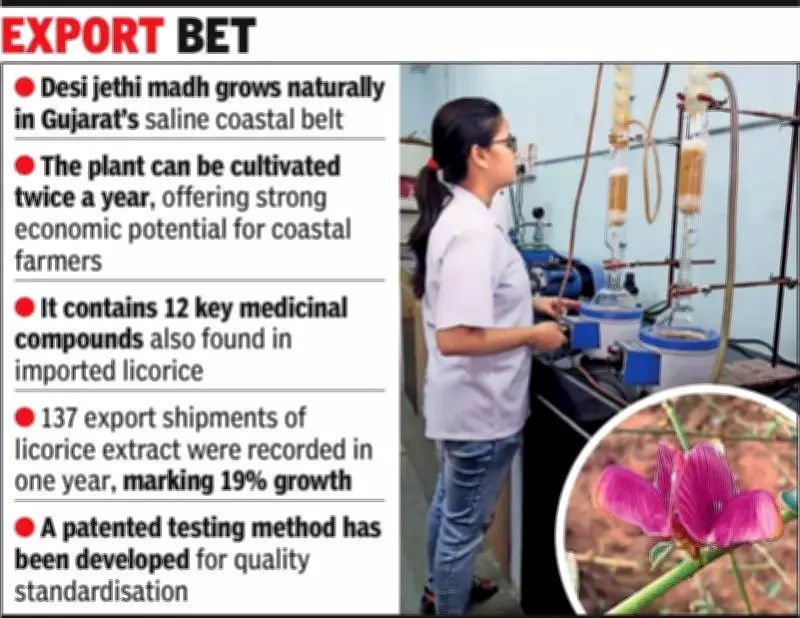
Recent data underscores this dynamic: from May 2024 to April 2025, India exported 137 shipments of licorice extract, reflecting a notable 19% growth. This growth trajectory highlights the potential for further expansion if domestic sourcing can be enhanced.
Phytochemical Analysis and Medicinal Potential
To assess the viability of desi jethi madh, Dwivedi conducted detailed phytochemical studies, analyzing 12 major compounds typically present in conventional licorice. All these compounds were detected in the indigenous variety, albeit in comparatively lower concentrations.
Dwivedi elaborated on the findings, noting, "All the major compounds were present. While the concentrations were lower, the medicinal potential is clearly established." The plant also contains natural antioxidants, anti-inflammatory compounds, and plant sterols that bolster immunity and overall health. Additionally, researchers observed that sweetness levels fluctuate with seasonal changes, increasing during specific periods.
Agricultural and Economic Implications
A significant advantage of this indigenous variety is its capacity for biannual cultivation, which could substantially boost output if promoted through scientific farming practices. Given its natural growth in saline coastal areas where agricultural alternatives are scarce, jethi madh presents new livelihood opportunities for farmers in these regions.
Another key outcome of this research is a patented analytical method developed by Dwivedi. This innovative technique allows for the simultaneous identification of multiple important compounds in a single process, enhancing efficiency in quality control and large-scale validation—tasks that traditionally require numerous complex tests.
Broader Context and Future Prospects
Licorice ranks among the world's most widely used medicinal plants, featuring in nearly 1,250 herbal formulations globally. This eight-year study was conducted under a research fellowship granted by the National Medicinal Plants Board under the Ministry of AYUSH, underscoring its alignment with national health and agricultural priorities.

By leveraging this salt-tolerant jethi madh, India could not only secure its licorice supply chain but also foster sustainable agriculture in challenging environments, ultimately strengthening its export economy and supporting local communities.





