

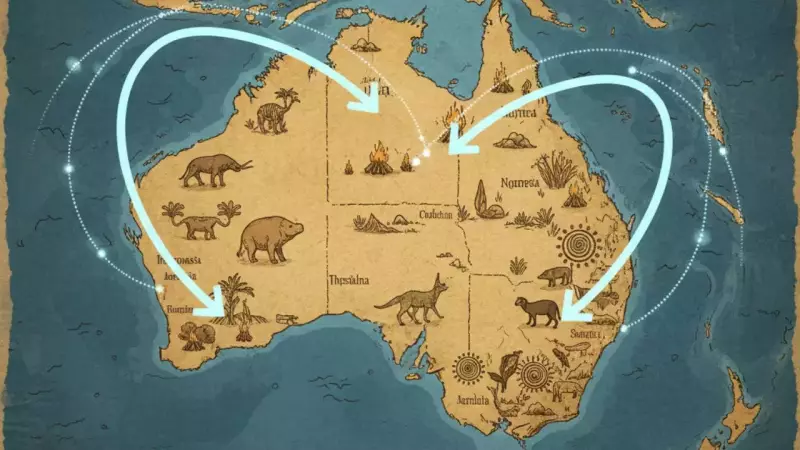
A groundbreaking new genetic analysis has finally settled one of archaeology's most enduring questions, providing definitive evidence that modern humans first set foot on the Australian continent approximately 60,000 years ago. This major finding aligns with the deep historical timelines preserved in Aboriginal oral traditions and reinforces archaeological evidence, offering a clear resolution to a decades-long scientific debate about the timing of this epic human migration.
Two Ancient Pathways Into a Lost Supercontinent
Published in the prestigious journal Science Advances, the research is based on a massive analysis of nearly 2,500 ancient and modern genomes from populations across Australia, New Guinea, and the Pacific islands. The data paints a detailed picture of not just when people arrived, but precisely how they undertook the monumental journey into the ancient landmass known as Sahul, which once connected Australia, New Guinea, and Tasmania.
The study reveals that the earliest ancestors of Aboriginal Australians and Papuans from New Guinea did not arrive as one homogenous group. Instead, they entered Sahul via two separate migration routes. One population moved southward, island-hopping through the Indonesian archipelago toward what is now northern Australia. A second, distinct group travelled through a northern corridor, likely passing through the Philippines before reaching New Guinea. These genetic pathways confirm long-held oceanographic and archaeological models that suggested multiple viable entries into the ancient continent.

Seafaring Pioneers and the Oldest Lineages Outside Africa
The research confirms that these journeys were only possible with the use of watercraft, as Sahul was never fully connected to mainland Southeast Asia, even during the ice age's lowest sea levels. This underscores the remarkable seafaring capabilities and knowledge possessed by these early explorers tens of thousands of years ago.
Both migrating groups were part of a larger population that migrated out of Africa between 70,000 and 80,000 years ago. The genetic data indicates that the ancestors of Australians and New Guineans diverged from each other somewhere in South or Southeast Asia thousands of years before their separate eastward journeys. Crucially, the study confirms that Aboriginal Australians and New Guineans carry some of the oldest continuous human lineages found anywhere outside Africa, a testament to their profound and unbroken connection to the land.
Resolving a Decades-Long Scientific Debate
For years, researchers have been divided, with some arguing for a human presence in Australia around 47,000 to 51,000 years ago, while others pointed to archaeological evidence suggesting an arrival as early as 65,000 years ago. This new, comprehensive genetic timeline strongly supports the earlier date of approximately 60,000 years ago, providing one of the most precise reconstructions to date.
The findings do more than just date arrival; they illustrate a pattern of ongoing movement and interaction. The study suggests that migration into Near Oceania, including islands like the Bismarck Archipelago and Solomon Islands, happened around the same broad period, pointing to a dynamic process of exploration rather than a single, isolated settlement event.
Ultimately, this large-scale genetic analysis, combined with archaeological and climate data, offers the clearest picture yet of one of humanity's greatest voyages. It scientifically validates what Indigenous communities have always known: their connection to Country stretches back at least 60,000 years, solidifying Australia's status as home to one of the world's oldest continuous cultures.






