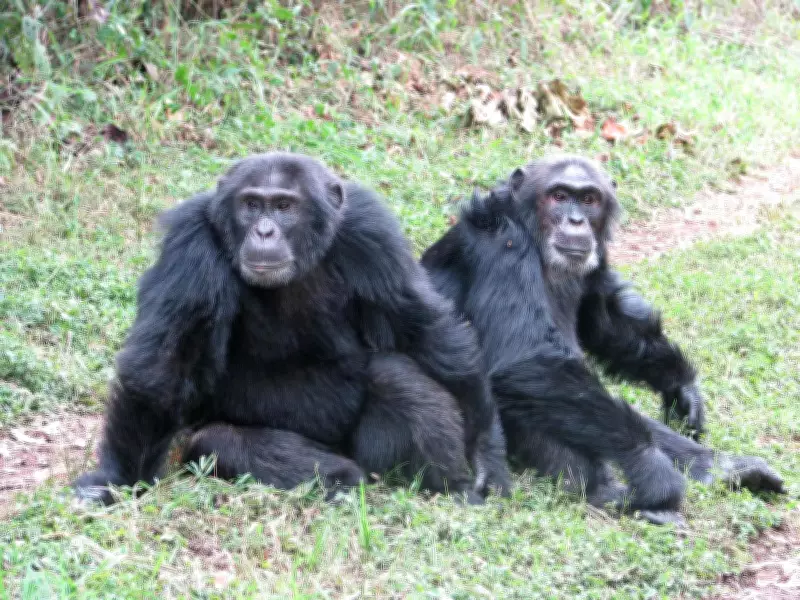
Pune: An ongoing civil war among chimpanzees in a Ugandan national park has renewed focus on fission events in animal societies. The conflict among the Ngogo chimpanzees — nearly 200 in total — has claimed at least 28 lives, including infants, since it erupted in 2018.
Rare Permanent Split
Scientists studying or following the internecine conflict in Kibale National Park say this is a rare, permanent split — only the second documented chimpanzee civil war following renowned primatologist Jane Goodall’s chronicling of the four-year clash (1974-78) among Tanzania’s Gombe chimpanzees.
Study Attributes War to Population and Resources
A recent study, published in the journal Science by primate behavioural ecologists, attributes the civil war to growing population, finite resources and more aggressive young males. Co-author John Mitani says the Ngogos had become unusually large: chimpanzee troops usually comprise 40-50 members; Ngogo had grown four times as big.

“As a consequence, within-group feeding and reproductive competition intensified, fracturing the community (into Central and Western subgroups) ... there was a change in the alpha male around the time hostilities broke,” says Mitani, who has observed the Ngogo chimps since 1985 with colleague, David Watts. Mitani has logged thousands of hours observing the Ngogo chimpanzees and the recent viciousness took him by surprise — chimpanzees which once co-existed were strategically hunting each other down. One example is seared into Mitani’s mind — two chimpanzees, Morton and Garrison, were inseparable before the split. Morton ended up in the Central group and Garrison in the Western. In 2024, the Western faction ambushed and killed Morton.
“Such brutality typically does not occur in other primate species after a fission. It’s difficult to explain why members of one group are killing individuals with whom they’ve shared a long history,” Mitani adds.
Fission Events in Other Animals
Over the decades, fission events have been seen among other animal groups (meerkats, red deer, Soay sheep, etc), though few have been as bloody as the Ngogo civil war.
British zoologist Tim Clutton-Brock found that dominant female meerkats in South Africa’s Kuruman river basin would expel weaker members, leading to skirmishes over foraging spots. Similarly, in Scotland, red deer fracture into matrilineal herds, but rival groups would only injure mating rivals; killings were rare. Since 1985, on Hirta Island, British evolutionary biologist Josephine Pemberton observed frequent discord among Soay sheep over dominance and mating rights.
It’s not all animals. Elephants, for instance, live in “fission-fusion” societies: they split into temporary need-based units with feeding, mating or other social considerations.
Elephant Societies Differ
Professor Vidya TNC, chair of evolutionary and organismal biology at Jawaharlal Nehru Centre for Advanced Scientific Research in Bengaluru, has been studying elephants in the Kabini region of Nagarahole and Bandipur National Parks for 17 years.
“Elephants form clans like chimp troops, but core ties persist … clashes stem from competition either for food or for mates. We have [never] seen this kind of a thing (like the Ngogo civil war),” Vidya says.
Stay updated with the latest Pune news. Download the TOI App.