Vijayawada: In a major infrastructure initiative aimed at improving pilgrimage connectivity while safeguarding fragile ecosystems, the Centre is advancing plans for an elevated corridor through the Nallamala forest region. This corridor will span the Nagarjunasagar–Srisailam Tiger Reserve (NSTR) and the Amrabad Tiger Reserve.
Project Overview
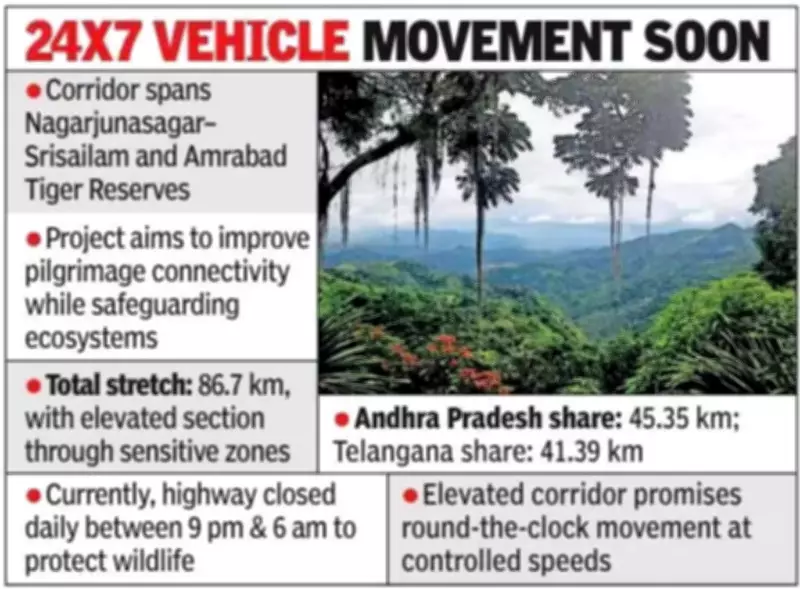
The project, initiated after Prime Minister Narendra Modi's visit to the Srisailam temple in October last year, is expected to provide seamless access from Andhra Pradesh and Telangana. Estimated at Rs 18,500 crore, the corridor will cover 86.7 km, with the elevated section running through sensitive zones between Dornala (Andhra Pradesh) and Bommenapalli (Telangana). Of this, 45.35 km lies in Andhra Pradesh and 41.39 km in Telangana, forming one of the most ecologically restricted stretches in the region.
Current Challenges
Currently, vehicular movement through the forest is tightly regulated, with the highway closed from 9 pm to 6 am to protect wildlife, particularly tigers. This restriction has long posed challenges for pilgrims and transporters. The existing ghat road is marked by steep gradients, sharp curves, and accident-prone stretches, adding to the difficulty. Traffic congestion peaks during festivals, further complicating access.

Design and Benefits
The elevated corridor aims to resolve these issues by enabling round-the-clock movement at controlled speeds, without disturbing animal activity below. The design proposes eco-sensitive pillars, long-span viaducts, and limited entry-exit points to minimize ground disturbance while bypassing hazardous terrain. Officials say the project could significantly cut travel time and improve safety standards for thousands of devotees, while strict speed regulations and monitoring systems will ensure compliance.
Regulatory Process
The Centre has sought detailed inputs from the forest departments of both states, given the project's passage through protected reserves. Based on these, the National Highways Authority of India (NHAI) will prepare a comprehensive report for clearance by the Ministry of Road Transport and Highways. If approved, it could set a benchmark for balancing connectivity, safety, and conservation in one of India's most populated tiger habitats.