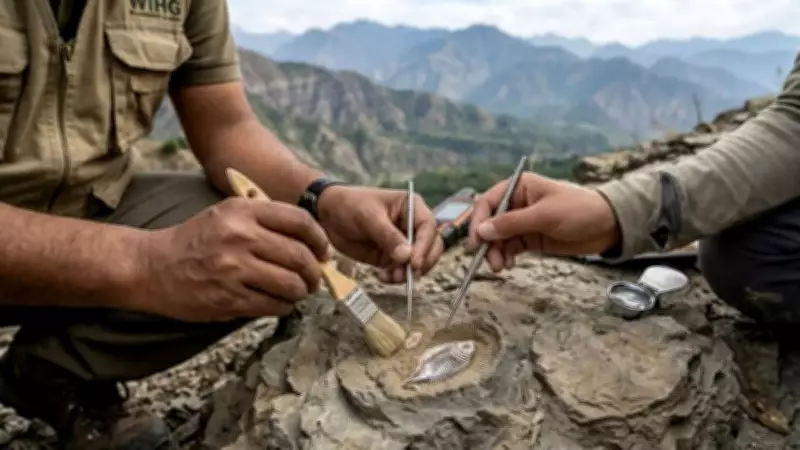
Groundbreaking Discovery of Ancient Aquatic Fossils in Shivalik Foothills
In a monumental breakthrough that fundamentally reshapes our understanding of India's geological history, researchers from the Wadia Institute of Himalayan Geology have unearthed some of the world's oldest known aquatic fossils. These remarkable specimens, dating back an astonishing 4.5 million years, were discovered in the Shivalik foothills near Mohand, along the Saharanpur-Dehradun border region.
Revolutionizing Knowledge of India's Geological Past
For thousands of years, the Shivalik Hills have been primarily recognized for their terrestrial animal fossils. This discovery completely transforms that narrative, providing the first definitive evidence of ancient perennial water bodies in northern India during the Pliocene period, which spanned from approximately 5 million to 2 million years ago.
The research team identified fossilized fish ear stones, scientifically known as otoliths, from several freshwater species. Among these was an exceptionally rare find: otoliths from a freshwater gourami fish (Trichogaster fasciata). This represents not only the first gourami fossil discovery in India but only the second recorded instance globally, following a previous finding in Sumatra, Indonesia.

Unprecedented Insights into Pliocene Freshwater Ecosystems
Otoliths are tiny calcium carbonate structures found in fish inner ears that help maintain equilibrium and enhance sound perception. The fossils studied, recovered from approximately 500 kilograms of bulk sediment collected during the 2024 field season, date between 4.5 and 4.8 million years ago.
In addition to the rare gourami, researchers discovered fossils of snakehead (Channa sp.) and goby (Gobiidae indeterminate) species. This diverse assemblage provides compelling evidence of a structured aquatic food chain with both ambush predators (snakehead) and smaller prey species (gobies).
Reconstructing Ancient Himalayan Environments
The discovery enables scientists to accurately reconstruct the ancient climate and environment of the Himalayan foothills. Gourami fish belong to the Osphronemidae family and typically prefer calm, still waters for spawning. Their presence indicates that 4.5 million years ago, this region hosted stable, lentic freshwater ecosystems rather than fast-flowing river systems.
The structured aquatic food chain suggests these ancient water bodies were surrounded by heavily vegetated areas, providing stable habitats that supported complex organisms. This finding stands in stark contrast to previously held views that the Pliocene Shivaliks were primarily terrestrial environments.
Scientific Validation and Collaborative Research
This groundbreaking discovery has been scientifically validated through publication in the peer-reviewed journal Palaeobiodiversity and Paleoenvironments, published by Springer Nature. The study, titled 'Otoliths of the Pliocene from Northwest India indicate the first osphronemid fossils and the structure of a Himalayan freshwater ecosystem in the Himalayas,' was led by Dr. Ningthoujam Premjit Singh of the Wadia Institute of Himalayan Geology.
The research represents a collaborative effort involving scientists from multiple institutions, including Doon University, Panjab University, the Academy of Scientific and Innovative Research at Ghaziabad, and the Biodiversity Research Centre of Taiwan. This multi-institutional approach has strengthened the findings and their significance for understanding India's geological evolution.
This discovery provides unprecedented evidence of 'statically stable' freshwater body environments in northern India during the Pliocene period, revealing ecosystems that supported complex aquatic food chains and were surrounded by dense vegetation. The findings fundamentally alter our understanding of the region's geological history and open new avenues for palaeontological research in the Himalayas.