Astronomers Detect Unfading 'Mega-Laser' Signal from 8 Billion Light-Years Away
In a groundbreaking discovery, astronomers have identified an extraordinarily strong "mega-laser" signal that has journeyed over 8 billion light-years to Earth without losing its intensity. This remarkable detection, made possible by the MeerKAT radio telescope in South Africa, challenges all scientific expectations about signal behavior across vast cosmic distances. Typically, signals weaken and distort as they traverse space, but this one remained bright and clear, sparking excitement in the scientific community.
What Is This Mega-Laser Beam Signal?
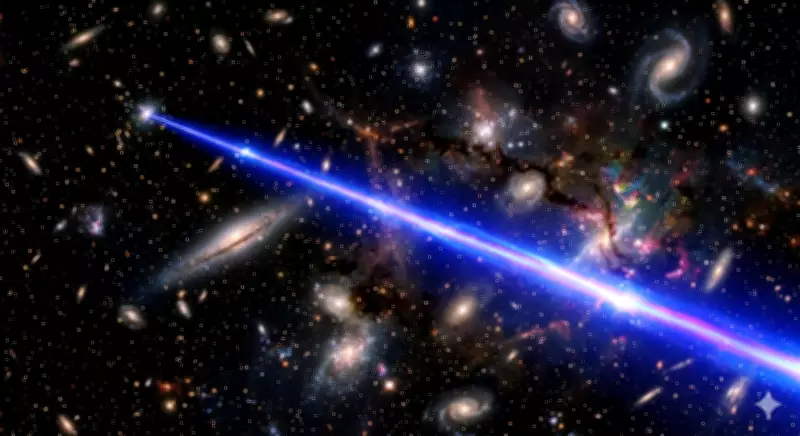
The so-called "mega-laser" is actually a hydroxyl megamaser, a natural phenomenon involving microwave amplification similar to lasers but operating at radio wavelengths. This occurs during galactic collisions, where gases are compressed, exciting hydroxyl molecules to emit intense radiation. In this specific case, the radiation originates from the HATLAS J142935.3–002836 galaxy system, located approximately 8 billion light-years from Earth. Researchers believe the exceptional intensity qualifies it as a "gigamaser," an even more powerful variant than typical megamasers.
Lead scientist Dr. Thato Manamela from the South African Radio Astronomy Observatory explains, "We are observing the radio equivalent of a laser halfway across the universe." This statement underscores the rarity and significance of the find, highlighting how it pushes the boundaries of our understanding of cosmic emissions.

Why This Cosmic Laser Refuses to Fade
One of the most puzzling aspects of this discovery is how the signal remained intact after traveling for eight billion years. Normally, such transmissions scatter throughout the universe, making detection difficult. However, in this instance, the signal gained additional power through a natural optical phenomenon known as gravitational lensing.
As Dr. Manamela elaborates, "The foreground galaxy acts like a magnifying glass on the signal coming from behind it." This cosmic coincidence amplified the signal's intensity, enabling its detection by the MeerKAT telescope. Gravitational lensing, where massive objects bend and focus light, played a crucial role in preserving the signal's strength, offering a rare glimpse into distant cosmic events.
What This Discovery Means for Astronomy
This discovery is far more than just an interesting fact; it provides a unique opportunity to study the universe at an earlier stage. Scientists believe that megamasers like this one can yield valuable insights into gas-rich environments and even supermassive black holes. Additionally, such space objects may aid in the future detection of gravitational waves, opening new avenues for astrophysical research.
In conclusion, researchers are optimistic about finding more signals of this nature. According to Dr. Manamela, "We don't want to find just one system... we want to find hundreds to thousands." This unprecedented mega-laser light reflects the vibrant and unpredictable nature of the universe, where a message that might have been lost in cosmic chaos instead shines brightly from millions of years ago.
As technology advances and telescopes like MeerKAT continue to evolve, scientists are beginning to uncover some of the universe's deepest secrets. This not only enhances our understanding of cosmic phenomena but also holds the potential for new discoveries and possibilities in astronomy.