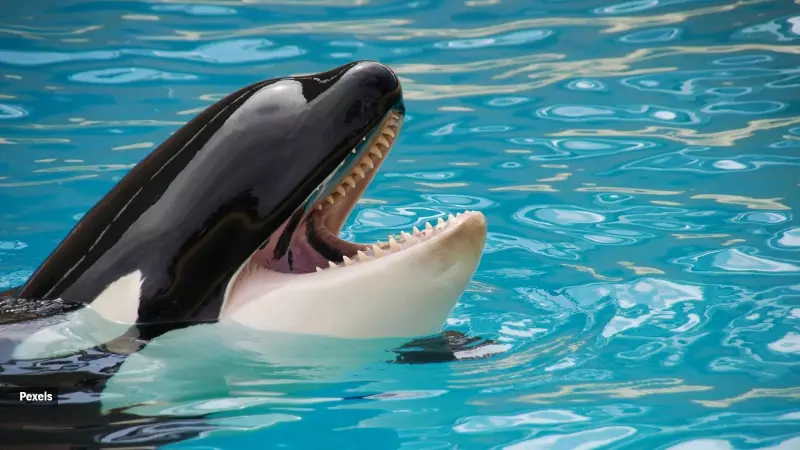
In a remarkable discovery that sheds new light on marine intelligence, scientists have observed orcas, commonly known as killer whales, using seaweed as tools to give each other what appears to be a gentle massage. This fascinating behaviour, documented in a study published on January 10, 2026, in the prestigious journal Current Biology, highlights the complex social lives of these ocean giants.
What is 'Allokelping'? The Kelp Massage Explained
Researchers observed that certain orcas actively pick up and bite off strands of kelp, a type of seaweed. They then drape these strands over the backs or flanks of other whales in their pod. The whales proceed to gently move the seaweed around, in a manner that closely resembles a therapeutic massage session. Dr Michael Weiss, the lead researcher, confirmed to BBC News that this activity is frequently seen, stating, "We see it multiple times per day."
Scientists have coined the term "allokelping" for this behaviour, drawing a direct parallel to the "allogrooming" seen in primates, where individuals spend hours cleaning each other's fur. "Let's call it a kelp massage," explained Professor Darren Croft from the University of Exeter and the Center for Whale Research in Washington State. "They're using the kelp to rub between themselves."

Why Do Orcas Do This? Theories Behind the Behaviour
The exact purpose of this kelp-based interaction is still being studied, but marine biologists have proposed several compelling theories. One school of thought suggests the behaviour may serve a hygiene or health function, potentially helping the whales remove parasites or relieve skin irritations. It could also be a method for the orcas to manage stress, much like a relaxing massage for humans.
Another prominent theory posits that "allokelping" is primarily a form of social play. This playful interaction is believed to strengthen social bonds and reinforce relationships within the tightly-knit pod, which functions much like a human family. Young orcas are often seen learning this skill by observing older members, indicating a cultural transmission of behaviour across generations.
A Landmark Discovery in Animal Tool Use
This discovery is significant because it represents one of the first well-documented cases of marine mammals using objects in a playful, non-hunting context. While tool use is known in species like chimpanzees (using sticks for termites) and crows (using twigs to probe for insects), observing such sophisticated, social object use in orcas is groundbreaking.
Orcas, which are technically the largest species of dolphin and not whales, are already renowned as the ocean's apex predators and for their high intelligence. They communicate with unique calls, coordinate complex hunting strategies, and live in sophisticated social structures. This new finding of recreational kelp use adds another layer to our understanding of their cognitive abilities and emotional complexity.
The study underscores that the oceans continue to be a source of wonder and unpredictable discoveries. The simple act of a killer whale offering a seaweed massage to a podmate reveals a world of social nuance and intelligence thriving beneath the waves, reminding us how much there is still to learn about the creatures with whom we share our planet.