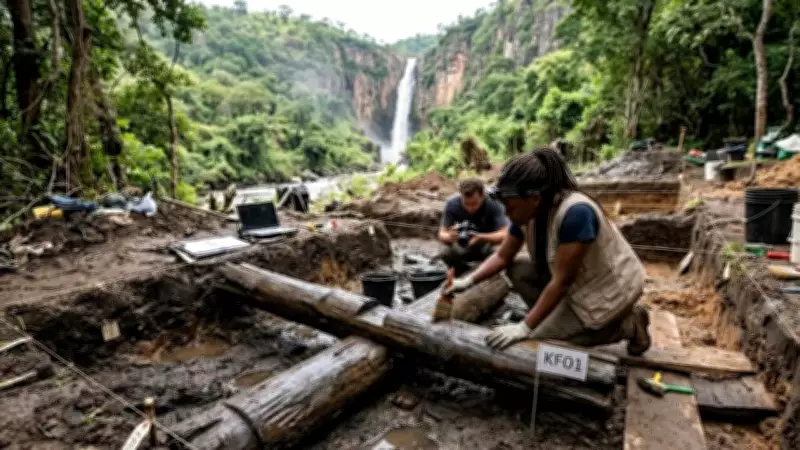
A wooden structure dated to 476,000 years ago has been unearthed at Kalambo Falls in Zambia, fundamentally altering our understanding of early hominin intelligence. Researchers from Aberystwyth University and the University of Liverpool uncovered interlocking logs that represent the oldest known example of wood used in construction.
Discovery Challenges Previous Beliefs
Remarkably, this structure predates the appearance of Homo sapiens by over 200,000 years. The waterlogged clay environment preserved the artefacts, revealing advanced carpentry skills such as using stone tools to notch timber for joining pieces. These findings indicate that Pleistocene ancestors were more than just wandering foragers; they possessed the cognitive ability to modify their environment for permanent living spaces. This revelation reshapes our understanding of early technological progress and human history.
Evidence of Abstract Thinking
A study published in the journal Nature details that the wooden structure consists of two logs fitted together with a deliberately crafted notch. This demonstrates that early hominins, such as Homo heidelbergensis, had the capacity for abstract thinking and design, challenging the previous notion that wood was only used for simple tools like digging sticks during the Middle Pleistocene.

Dating the World's Oldest Wood
To determine the age of the find, scientists employed luminescence dating on the surrounding sand, a technique that reveals when minerals were last exposed to sunlight. The results showed the wood is approximately 476,000 years old, far surpassing the previous record for a wooden structure, which was between 9,000 and 11,000 years old.
Evidence of High-Level Cognitive Planning
The artefacts provide clear evidence that our ancestors deliberately shaped wood using stone tools. Researchers at the University of Liverpool found that the pieces were crafted to fit together, akin to modern joinery techniques. This discovery shifts the archaeological focus from primarily stone tools to recognizing a significant 'Wooden Age', implying that species before Homo sapiens possessed advanced cognitive and physical skills.
Preservation at Kalambo Falls
The exceptional preservation of these wooden artefacts is due to the unique waterlogged conditions at Kalambo Falls. The absence of oxygen prevented decay, allowing the wood to survive for nearly half a million years. Located near a high waterfall on the Zambia-Tanzania border, the site contains an extensive record of human history from the Stone Age through the Iron Age.