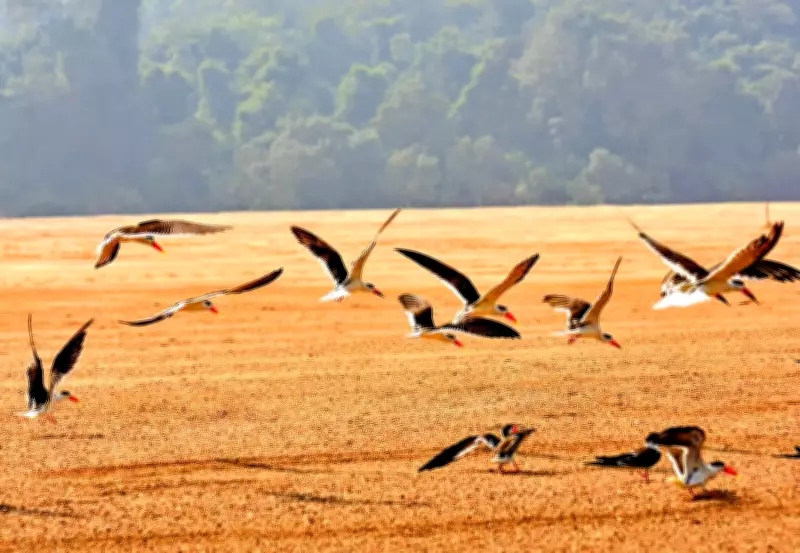
Bhubaneswar: Indian skimmers have laid eggs and bred for the first time on the sandbar of Mahanadi gorge inside Mahanadi Wildlife Sanctuary, indicating its protective environment and the skimmer's long-term survivability.
The skimmer species of birds have been sighted there repeatedly in recent years, but egg laying and breeding were not previously noticed in the sanctuary. Wildlife officials confirmed evidence of their breeding in other parts of Odisha.
“For the first time, the endangered Indian skimmer has successfully laid eggs and bred on a mid-river sandbar in the Mahanadi division at Nayagarh under Satkosia Tiger Reserve, marking a major conservation milestone in Odisha,” said DFO (Mahanadi) Amaresh Pradhan.

He stated that the skimmer, long regarded in Satkosia gorge as a winter migrant, has shown a significant behavioral shift this year by nesting and raising chicks within the protected stretch of Mahanadi. “Our staff, along with researchers, recorded 16 nests with 53 eggs at the onset of March on the sandbar habitat inside the gorge. In April, chicks emerged and are now being raised,” Pradhan added.
The first chick was sighted on April 25. At present, 27 healthy hatchlings are visible along the riverside, closely guarded and fed by parent birds. Wildlife officials said the successful breeding event has generated excitement among wildlife managers and bird researchers, as it signals the emergence of Satkosia as a new breeding site for the globally threatened species.
Traditionally, Indian skimmers breed between March and May in the Cuttack-Munduli belt. Flocks migrate to Satkosia gorge in October-November, remain through winter, and usually return to their breeding grounds by February.
“Habitat conditions in Satkosia appear to have improved enough to retain some birds throughout summer,” said the DFO.
Officials attribute this change largely to the no-fishing zone imposed in Mahanadi since 2019 for the recovery of gharials. The restriction sharply reduced human disturbance, including fishing pressure, sand mining, and other anthropogenic activities in the riverine ecosystem. As a result, undisturbed sandbars and a rich prey base have created ideal microhabitats for skimmers.
Researchers say a few birds began nesting in the area in 2022, and annual monitoring has since documented a gradual rise in breeding pairs and fledgling success. The latest nesting season is being seen as strong evidence that sustained habitat protection can help revive sensitive river-dependent birds.