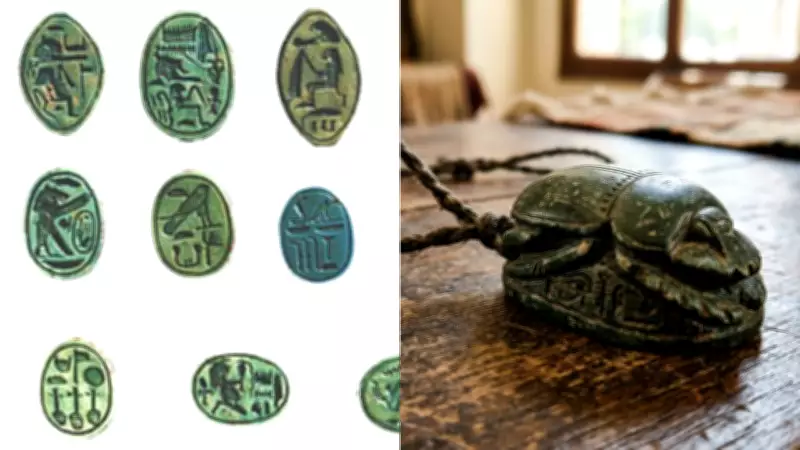
Archaeologists have uncovered a remarkable Egyptian amulet in an ancient grave in Spain, shedding new light on early cultural exchanges between civilizations across continents. This discovery, detailed in the study 'Egyptian Amulets in the Western Mediterranean: The Case of Cadiz,' provides evidence of contact between ancient Egyptians and inhabitants of the Iberian Peninsula much earlier than previously believed.
Discovery of the Amulet
The intricately designed amulet was excavated at a burial ground in Cadiz, Spain, dating to the beginning of the first millennium BCE. Ancient Egyptians considered amulets to hold great significance beyond mere ornamentation; they played a vital role in religious, spiritual, and funerary rituals. The amulet's design and material closely resemble those of Egyptian amulets, suggesting it was either imported from Egypt or used by individuals with ties to Egyptian civilization.
Ancient Trade Routes and Cultural Exchange
This find supports existing theories about ancient trade links among Mediterranean civilizations. Cultures such as the Phoenicians acted as intermediaries, facilitating the exchange of goods and beliefs between Egypt and regions like present-day Spain. Previous evidence, including jewelry, pottery, and religious objects, pointed to these trade connections. However, the discovery of a sacred Egyptian amulet in a Spanish grave adds a deeply personal dimension to the narrative, indicating not only the movement of objects but also the transmission of cultural and religious practices.

Cultural and Religious Significance of Egyptian Amulets
In ancient Egyptian belief, amulets possessed protective powers and were associated with gods, the afterlife, and the wearer's security. The presence of such an amulet outside Egypt raises intriguing questions: Did the deceased understand its religious significance, or was it valued simply as an exotic artifact? This discovery underscores the complex interplay between material culture and belief systems in ancient times.
Implications for Archaeology
This discovery highlights early globalization in the ancient world, demonstrating how interconnected societies were thousands of years ago. It reveals the impact distant cultures had on local identities. Future studies will likely analyze the amulet's material composition and compare it with other sites to determine its exact origin. Researchers aim to establish whether the artifact was directly imported from Egypt or produced locally by artisans influenced by Egyptian traditions. The finding of a sacred Egyptian amulet in a prehistoric Spanish tomb is not only archaeologically fascinating but also symbolically significant, illustrating the deep cultural ties that spanned the ancient Mediterranean.