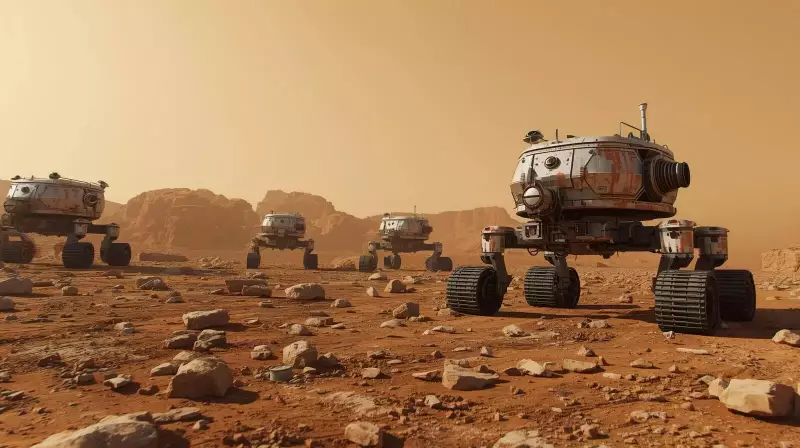
While visions of Mars often feature astronauts and rockets, the real groundwork for human survival is being laid right now by unassuming robotic explorers. In labs and control rooms, scientists are using data from these machines to solve the gritty, unglamorous problems that will determine if humans can work, live, and return safely from the Moon and Mars.
From Robots vs. Humans to Robots & Humans
The old debate framing space exploration as a choice between robots and astronauts is fading. As reported on Space.com, the narrative is shifting towards collaboration. Robotic missions act as advanced scouts, measuring risks and testing environments. Human missions will then build directly upon this crucial groundwork. It's a partnership where robots go first and continue working even after crews arrive.
Tracking Martian Radiation in Real-Time
Radiation is one of the most severe threats to any Mars mission, due to the planet's thin atmosphere and lack of a global magnetic shield. Scientists are already building practical tools to manage this. Gina DiBraccio from NASA Goddard described a decision-support tool, originally for Earth, now being fed data from Mars orbiters and rovers like MAVEN, Curiosity, and Perseverance.

The goal is straightforward: future astronauts on Mars could open a tablet to see real-time space weather. If a dangerous solar flare is approaching, they would know exactly when to seek shelter. This isn't speculative software; it's a functional system being assembled piece by piece with current data.
Long-Running Missions Reveal Vital Patterns
Some of the most valuable insights come from missions that have collected data for years. The MAVEN orbiter, though no longer active, studied Mars's upper atmosphere and space environment for over a decade. Principal investigator Shannon Curry explained that scientists have now compiled a full catalogue of Martian space weather events across an entire solar cycle from 2014 to 2025.
This long-term view allows researchers to see patterns, not just isolated moments. They can now estimate how often dangerous radiation levels occur and under what solar conditions. This knowledge directly informs the design of surface habitats, mission plans, and daily routines for future crews.
The Elusive Hunt for Lunar Water
Finding water on the Moon is more complex than it seems. Evidence points to the lunar south pole, where water ice is trapped in permanently shadowed craters. However, pinpointing its exact location is like knowing water exists in a city but not which street. Current datasets conflict, showing ice in different craters.
To resolve this, NASA has selected a new imaging spectrometer. From lunar orbit, it will map water and minerals with much sharper clarity, acting as better eyes for astronauts deciding where to land and establish operations.
The Persistent Peril of Lunar Dust
Often underestimated, lunar dust is a serious operational hazard. Apollo astronauts found it to be sharp, clingy, and damaging to suits, equipment, and human lungs. Scientists now rank dust among the top threats to sustained lunar activity.
New missions aim to understand how dust behaves when humans are present. An instrument called DUSTER, flying on the Artemis IV mission, will measure dust and plasma near the surface, studying how walking or driving stirs it up. Another tool, a compact dust analyser, is built to survive rough landings and function in extreme conditions. The solution isn't removing dust but learning to live with it.
Seeking Natural Shelters on Mars
While Mars lacks a planetary magnetic field, parts of its crust retain localised magnetic patches. These areas might offer pockets of limited radiation shielding. Researchers are exploring whether small drones, similar to the Ingenuity helicopter, could carry magnetometers to map these regions at close range. The objective is pragmatic: to identify better locations for building bases, planning routes, and taking pauses.
The essential work continues quietly. Robots move first, collect data, and wait. Human missions to Mars and the Moon remain on the horizon, but their shape and safety are being meticulously crafted today by the patient, unsung work of machines already there.