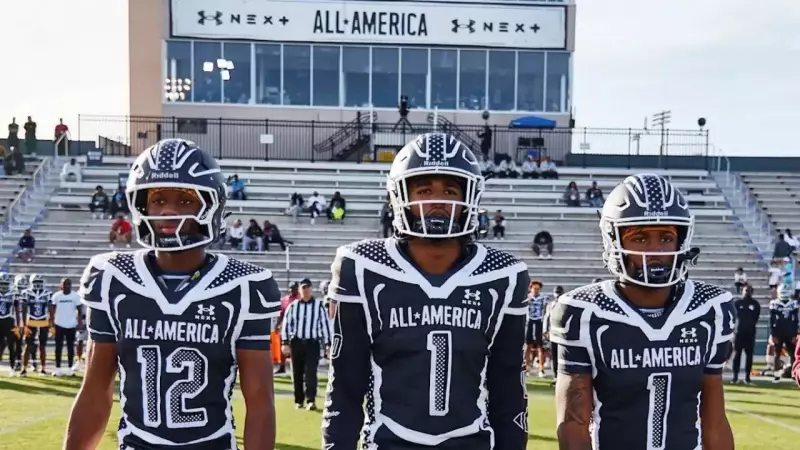
In a striking display of automation replacing gruelling manual work, a GPS-guided robot handled the complex task of painting the football field for the upcoming 2026 Under Armour Next All-America Game in DeLand, Florida. The machine, affectionately nicknamed "Tank Williams Jr." by the grounds crew, completed in mere hours a job that traditionally consumed several days of human labour.
From Four Days to a Few Hours: The Robotic Revolution on the Field
The scene unfolded at Spec Martin Stadium, where preparations were underway for its second consecutive Under Armour Next All-America Game. Instead of a large team with sprayers and stencils, a single crew member supervised the Turf Tank robot as it meticulously painted a 40-yard midfield logo featuring "All America" arched above three roses. Brad Keith, DeLand's sports turf superintendent, revealed the dramatic time savings. Before the robot, Keith and a team of six to eight people needed a full four days to hand-paint yard markers, numbers, end-zone logos, and midfield emblems.
"We had been using them to come out and paint (Spec Martin Stadium) and quickly realized that it saved us from having six employees over here," Keith told the Daytona Beach News-Journal, which first reported the details. "We could legitimately leave one employee over here and paint the whole field." This efficiency is crucial for Keith, who oversees multiple venues including Stetson University's facilities and a nearby Little League complex. The freed-up staff can now focus on other maintenance work across the city.

Precision, Safety, and the Rise of Turf Tank
The shift to robotic painting is not merely about convenience or aesthetics; it's fundamentally about labour optimisation, pinpoint accuracy, and enhanced player safety. Ken Rathman, Turf Tank's special operations manager, explained why precision is non-negotiable: "Here in football and other sports too, inches means if you're winning a game or losing a game." The robot ensures lines are perfectly straight and positioned exactly according to regulation, eliminating human error.
The Turf Tank Two Pro model used in DeLand weighs 102 pounds, holds 5.5 gallons of paint, and uses a remote base station connected to satellites to map GPS coordinates for flawless field layouts. According to data from the company, a standard football field without complex logos can be marked in under 3.5 hours. The midfield artwork for the All-America Game is temporary; it will be erased after the January 3rd event and repainted for the Hula Bowl ahead of its January 10 showcase.
Interestingly, the technology does not completely remove humans from the process. Crews still manually spray the coloured end zones and monitor the robot for any operational issues. "It's basically everything that you're used to doing," Keith said. "It's just allowing the robot physically on the field."
A Global Impact on Sports Field Management
The company behind the robot, Turf Tank, has an inspiring origin story. It began as a high school project in Denmark in 2014 under the name Intelligent Marking. Founders Anders Sorensen and Anders Ydesen later partnered with Jason Aldridge to formally launch the company in 2016. Its impact is now global. Reports cited by the Los Angeles Times indicate that Turf Tank machines are used by eight NFL teams, numerous MLS and NWSL clubs, and hundreds of colleges and universities.
This automation is particularly beneficial for smaller markets and organisations with limited staff who must manage multiple venues on tight schedules. Keith has already embraced further automation, deploying robotic lawn mowers at Spec Martin Stadium and the Sperling Sports Complex. For him, the ultimate goal is clear: "We also need to keep these kids safe. That's the No. 1 goal of every turf manager, safety first."
The 2026 Under Armour Next All-America Game is scheduled to kick off on Saturday, January 3, at 4 p.m. Eastern Time, with live broadcast on ESPN. When viewers admire the pristine field, they will be looking at the work of a robot—a change that resulted in fewer people, fewer hours, and significantly fewer errors. That, as they say, is the entire point of the technological touchdown.