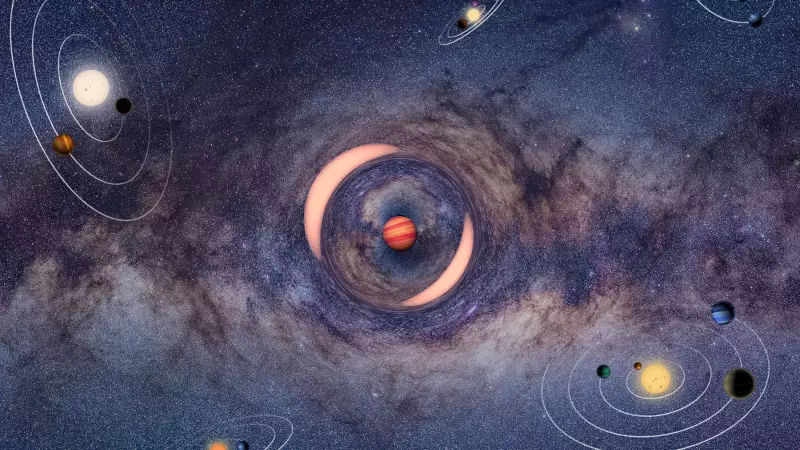
In a remarkable discovery that pushes the boundaries of our cosmic understanding, astronomers have confirmed the existence of a rare, Saturn-sized planet drifting completely alone through the vast darkness of interstellar space. This celestial wanderer, located nearly 10,000 light-years from Earth, is one of the clearest examples yet of a rogue planet that does not orbit any host star.
A Lonely Giant in the Galactic Core
The discovery was made possible by an international team of scientists who observed an unusual distortion in the light from a distant star back in 2024. This brief brightening event, a signature of a phenomenon called gravitational microlensing, was captured simultaneously by multiple ground-based telescopes and the European Space Agency's now-retired Gaia spacecraft. By analyzing this event from different vantage points, researchers pinpointed the object's location about 9,950 light-years away, toward the crowded centre of our Milky Way galaxy.
This marks a significant first. For the first time using this detection method, scientists were able to determine both the precise distance and the mass of such a free-floating planet. The world is estimated to have a mass roughly 70 times that of Earth, making it comparable in size to the ringed planet Saturn. This precise measurement rules out the possibility that the object is a failed star, known as a brown dwarf, solidifying its classification as a true planet.

How Do Planets Go Rogue?
The existence of such solitary worlds is supported by theoretical models of how planetary systems evolve. Researchers believe these rogue planets are likely ejected from their home systems due to violent gravitational interactions during the system's chaotic early history. In some scenarios, close encounters with passing stars can fling planets away from their suns, sending them on an eternal journey through the galaxy.
Some scientists also theorise that a number of these objects may not have been ejected at all. Instead, they could have formed in isolation, collapsing directly from clouds of gas and dust in a process similar to star formation, but on a smaller planetary scale. This discovery strengthens the view that such starless planets may be far more common in the Milky Way than astronomers once believed.
The Future of Hunting Lonely Worlds
Detecting these dark, wandering planets remains a formidable challenge because they emit little to no light of their own. The gravitational microlensing technique is currently the most effective tool. It works when the rogue planet's gravity acts as a lens, briefly bending and magnifying the light from a background star as it passes in front of it.
The future of this search is bright. Upcoming space observatories are set to revolutionise the hunt for these elusive worlds. NASA's Nancy Grace Roman Space Telescope, scheduled for launch as early as 2026, will survey vast regions of the galaxy at unprecedented speed. Similarly, China's planned Earth 2.0 mission is also expected to join the search for free-floating planets later this decade.
The findings, published online on January 1 in the journal Science, offer a compelling glimpse into a hidden population of planets. This discovery suggests the galaxy could be teeming with billions of such lonely worlds, potentially rivaling stars in number, and is reshaping how scientists understand the formation, evolution, and sometimes violent disintegration of planetary systems.