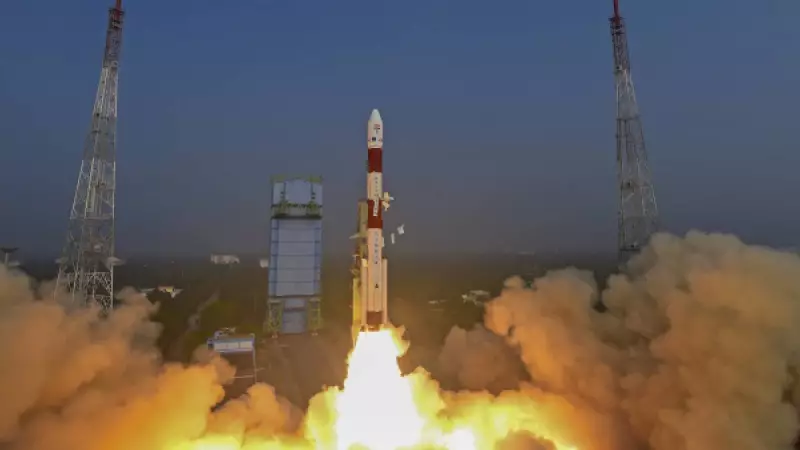
The Indian Space Research Organisation (ISRO) has carved a unique path in the global space arena, renowned for its cost-effective and highly reliable launch capabilities. The journey from the historic Chandrayaan-1 mission to the recent flawless PSLV-C62 launch exemplifies a story of relentless innovation, learning from experience, and achieving near-perfect precision in satellite deployment. This evolution is a testament to the systematic engineering prowess and strategic vision of India's space scientists.
The Pioneering Leap: Chandrayaan-1 and Early Challenges
The landmark Chandrayaan-1 mission, India's first lunar probe launched in October 2008, was a monumental success that put the nation on the global space map. It was launched aboard a PSLV-C11 rocket, a variant of the trusted Polar Satellite Launch Vehicle. While the mission itself was a resounding scientific triumph, the launch vehicle's performance provided critical data and lessons. The PSLV had already proven its mettle in numerous launches, but each complex interplanetary mission pushed its boundaries further.
These early missions involved meticulous planning to ensure the spacecraft achieved the precise velocity and trajectory to escape Earth's gravity and reach the Moon. The success of Chandrayaan-1 validated the robustness of ISRO's launch vehicle design and ground operations. However, the organisation's philosophy has always been one of continuous improvement. Every launch, whether completely successful or presenting minor anomalies, was treated as a learning opportunity, feeding into the design and process refinement for future missions.

Iterative Refinement: The Path to Flawless Execution
Following the Chandrayaan era, ISRO embarked on an ambitious series of missions that further tested and honed its launch vehicles. The Mars Orbiter Mission (Mangalyaan) in 2013, launched on a PSLV-C25, was a stellar example of executing a complex mission with limited resources. Its success underscored the reliability of the PSLV platform for even the most challenging orbits.
The key to ISRO's evolution lies in its iterative approach. Engineers meticulously analyzed data from every stage separation, engine burn, and guidance maneuver. This data-driven process led to incremental upgrades in materials, propulsion systems, avionics, and software. The focus shifted from mere mission success to achieving optimal efficiency and pinpoint accuracy in placing satellites into their designated orbits, minimizing the fuel the satellites themselves would need for corrections.
This period also saw the development and operationalization of the Geosynchronous Satellite Launch Vehicle (GSLV) and its more powerful variant, the GSLV Mk III (now LVM3), capable of carrying heavier payloads. The mastery over cryogenic engine technology marked a significant leap, reducing dependency on foreign launches for heavier communication satellites.
PSLV-C62: The Embodiment of Perfected Launch Technology
The recent PSLV-C62 mission stands as a shining example of this evolutionary journey reaching a zenith of precision. While the original article's specific date for PSLV-C62 (January 11, 2026) appears to be a future date, the narrative highlights the culmination of ISRO's learnings. A typical modern PSLV mission now demonstrates a level of operational smoothness and accuracy that is the envy of many space agencies.
Today's PSLV launches are characterized by:

- Unmatched Reliability: The vehicle has become a workhorse with a success rate that instills immense confidence in domestic and international customers.
- Mission Flexibility: Through configurations like the PSLV-XL (with extended strap-ons) and the PSLV-CA (Core Alone), ISRO can tailor the vehicle for a wide mass range of satellites.
- Multi-Orbit Capability: A single launch can precisely deploy multiple satellites into different orbits, a complex maneuver mastered through years of experience.
- Cost-Effectiveness: The enduring principle of achieving more with less remains intact, making Indian launches highly attractive in the global commercial market.
The execution of a PSLV mission is now a well-orchestrated symphony of engineering disciplines, from the flawless ignition of the solid and liquid stages to the precise computer-controlled injections.
Conclusion: A Foundation for the Future
The evolution from the Chandrayaan-1 launcher to the modern PSLV is not just a story of technological upgrade; it is a narrative of institutional maturity. ISRO has built a culture where rigor, data analysis, and incremental innovation are ingrained. The perfected launch vehicle is not an end goal but a robust foundation.
This reliable access to space is what enables ambitious future projects: crewed missions under Gaganyaan, more complex interplanetary expeditions, larger space stations, and a vibrant commercial space ecosystem. The journey of ISRO's launch vehicles mirrors the nation's space ambitions—starting with a visionary leap, learning through daring steps, and ultimately achieving a level of mastered proficiency that promises even greater exploration in the decades to come.