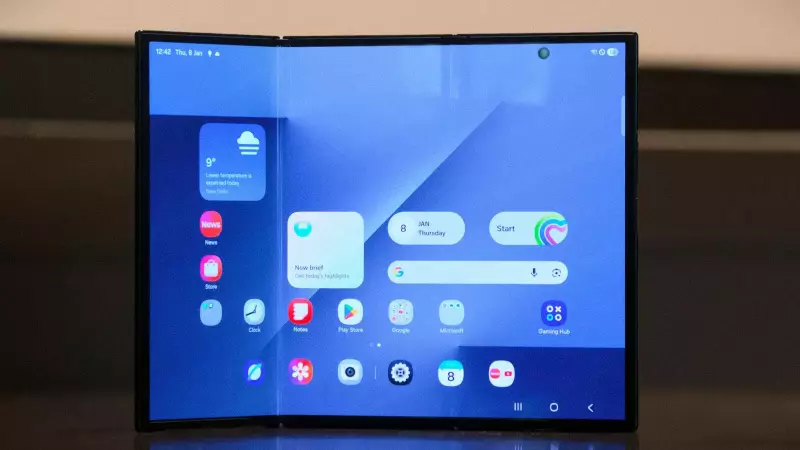
The first experience of unfolding Samsung's new Galaxy Z TriFold is nothing short of a minor cognitive shock. It feels like witnessing a clever magic trick—you know the mechanics, but the result leaves you pleasantly bewildered. After a brief but impactful hands-on session, the device leaves a lasting impression, not due to complexity, but because it genuinely feels like holding a slice of tomorrow's technology today.
The Engineering Marvel: From Chunky Phone to Ultra-Thin Tablet
Let's be clear about one thing first: when closed, the Galaxy Z TriFold is a substantial device. It measures 12.9mm in thickness and weighs 309 grams, making it noticeably bulkier than the current Z Fold 7 and reminiscent of the heft of older models like the Z Fold 5. This seems counterintuitive after years of Samsung slimming down its devices.
However, the rationale becomes crystal clear the moment you begin to unfold it. The process—opening the right panel first, followed by the left—is surprisingly smooth, thanks to a sophisticated dual-hinge system with magnets that provide deliberate, satisfying resistance. Once fully opened, you are no longer holding a thick phone but a legitimate 10-inch tablet that was just in your pocket.

The transformation is staggering. In its fully unfolded state, the TriFold is a mere 3.9mm at its thinnest point. This makes it thinner than both the Z Fold 7 (4.2mm) and Samsung's slimmest traditional phone, the S25 Edge (5.8mm). The engineering trade-off is brilliant: chunkiness when folded for unparalleled thinness when deployed as a tablet.
A Screen That Demands Your Attention
Unfolded, the device presents a stunning 10-inch AMOLED display with a 4:3 aspect ratio. This is a proper tablet screen, a significant step up from the squarish displays of previous Z Fold models. During the demo, viewing content like the trailer for Christopher Nolan's "The Odyssey" was an immersive experience, free from the constraints of letterboxing.
The 4:3 ratio also promises a superior reading experience, offering ample vertical space that should eliminate constant scrolling. However, the true game-changer is Samsung DeX. On the TriFold's expansive screen, the desktop mode transitions from a neat trick to a genuinely practical feature. Paired with a Bluetooth keyboard and mouse, it could feasibly replace a laptop for many tasks, offering a multi-window workspace that doesn't feel cramped.
Thoughtful Details and Unavoidable Compromises
Samsung has paid attention to the details. The visibility of the crease is reduced compared to earlier foldables, and a carbon fiber-like back offers better grip. An intelligent system prevents incorrect folding by vibrating and displaying a warning. However, some compromises are inherent to the inward-folding design.
You're locked into two modes: the narrow 6.5-inch cover screen or the full 10-inch tablet, with no intermediate option like Huawei's Mate XT offers. When closed, the beautiful screens are hidden behind thick bezels. Battery life is another concern. The 5600mAh battery sounds large, but powering a 10-inch display and intensive multitasking in DeX mode could challenge its endurance, especially when compared to modern slab phones with 7000mAh+ capacities.
Verdict: A Halo Product That Asks More Questions
The Galaxy Z TriFold creates a unique dilemma: you might dislike its folded bulk but adore its unfolded potential. It challenges the industry's obsession with thinness, proving that thickness is contextual. This device isn't just a phone; it's a versatile tool that morphs to fit your needs.
However, its appeal comes at a steep price. Based on its South Korean pricing of approximately 3.6 million won, it could cost around $2,500 or ₹2.2 lakh in India. At that price, one could buy a top-tier phone and a premium tablet. Sadly, Indian consumers won't get that choice, as Samsung has no official plans to launch the TriFold in India. It is slated for release in South Korea, the US, and a few other select markets.

Ultimately, the Galaxy Z TriFold is a halo product. It's not designed for the masses but for early adopters who crave cutting-edge innovation. It doesn't have to make practical or financial sense for everyone. Its mission is to expand our imagination of what a smartphone can be. And in that, Samsung has unequivocally succeeded.