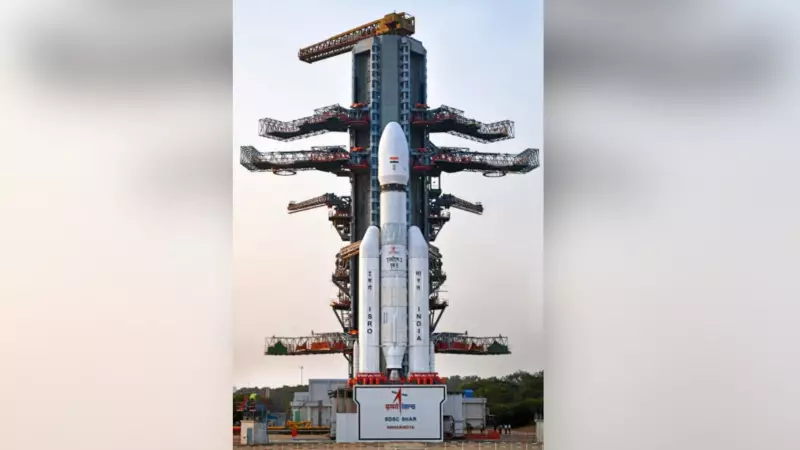
India's landmark human spaceflight program, Gaganyaan, is poised for a critical milestone with its first uncrewed mission now likely to lift off by March 2026. This mission, designated HLVM3 G1/OM1, marks a significant step after the project faced multiple delays since its grand announcement by Prime Minister Narendra Modi from the Red Fort in 2018.
A Timeline of Shifting Deadlines
Originally envisioned to coincide with India's 75th year of Independence in 2021, the Gaganyaan mission's schedule has been a moving target. The global pandemic introduced severe supply chain and manufacturing hurdles for the Indian Space Research Organisation (ISRO), leading to subsequent missed deadlines. Initial plans for at least one mission in FY23 were scaled down to zero for both FY23 and FY24. While ISRO later committed to two missions in FY25, its latest annual report now outlines an ambitious plan for three missions in FY26, a target that appears challenging.
The official launch campaign commenced in December 2024, signaling the start of intensive pre-launch activities. Key milestones included the assembly of the first solid motor for the rocket's first stage beginning on December 18, 2024, and the integration of the crew and service modules. By January 2025, the crew module, fitted with propulsion systems and an uprighting system, was dispatched for further integration.

Rigorous Systems Testing Paves the Way
Despite the launch delay, ISRO has completed a battery of crucial tests to qualify various systems for the historic mission. The safety-critical Crew Escape System, designed to whisk astronauts away from the launch vehicle in an emergency, has seen its high-altitude, low-altitude, and jettisoning motors successfully tested.
The agency has also validated the Crew Module Thermal Protection System and the complex 10-parachute system essential for a safe, slow descent and splashdown. Integrated air drop tests were conducted to check the parachute system under normal and extreme conditions. Furthermore, the Human Rated Cell Board (HRCB) has certified astronaut-carried articles like the emergency survival kit, food containers, and dosimeters.
Other completed checks include performance tests for the half-humanoid robot, the crew module's communications system, and the service module's on-board computer, ensuring they can withstand launch vibrations and the harsh vacuum of space. The first of the planned Gaganyaan Analog Experiments (Gyanex) was also conducted this year.
The Expanded Mission Calendar and Future Outlook
The scope of the Gaganyaan programme has expanded significantly. From the initial plan of two uncrewed and one crewed mission, the revised roadmap now includes eight missions—six uncrewed and two crewed. This expanded list also incorporates the establishment of the first module of the Bharatiya Antariksh Station, originally targeted for 2028.
As per the current timeline, following the first uncrewed mission in Q1 of 2026, the first crewed mission is not expected until late 2027 or early 2028, indicating further delays for subsequent flights. Alongside Gaganyaan, ISRO has set a packed calendar for the year, planning at least six missions including earth observation satellite launches on PSLV and GSLV rockets, a technology demonstration, and a commercial SSLV mission.
The upcoming uncrewed flight will utilize an unpressurised crew module to demonstrate the complete mission profile: the human-rated launch vehicle will place the spacecraft in Low Earth Orbit, ensure the module's re-entry, and accomplish a smooth splashdown and recovery operation, setting the stage for India's era of manned space exploration.