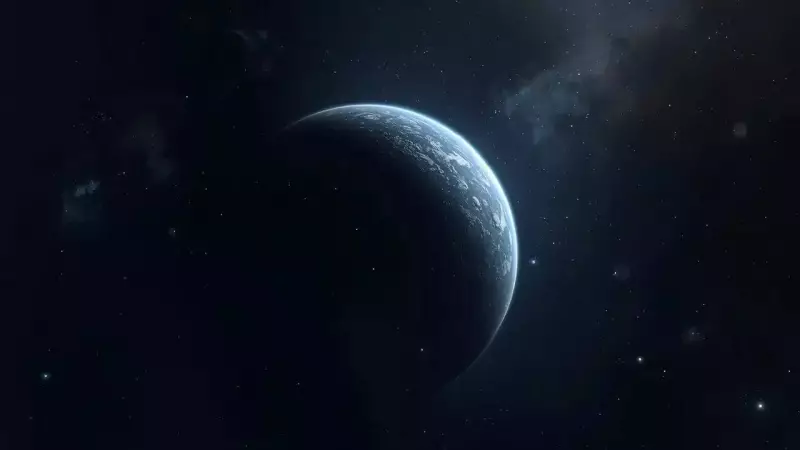
In a groundbreaking discovery, astronomers have confirmed the existence of a planetary body, with a mass comparable to Earth, wandering alone through the vast expanse of our Milky Way galaxy. This object, known as a free-floating or rogue planet, is not bound by gravity to any star, including our Sun, marking a significant milestone in astronomical observation.
How Scientists Spotted the Solitary Wanderer
The elusive planet was detected using a sophisticated technique called gravitational microlensing. This method relies on the bending of light due to gravity. When the rogue planet passed precisely between Earth and a distant background star, its gravitational field acted like a lens, briefly magnifying and brightening the star's light.
The resulting signal, known as a light curve, was unusually short, lasting only a few hours. This brief duration was the key clue that the object causing the lensing was of planetary mass, rather than a star or a brown dwarf. The event was captured in a densely populated star field, where continuous, high-cadence monitoring was crucial to catching the rapid brightening and fading.

Follow-up observations found no detectable light coming from the lensing object itself at optical or infrared wavelengths. Detailed modelling of the event, published in the journal Science, ruled out other explanations like stellar variability, confirming the discovery of a solitary planetary mass body.
What We Know About This Lonely Planet
Analysis of the microlensing data allowed scientists to estimate the rogue planet's mass as being similar to Earth's. The calculations were based on the event's timescale and the inferred relative motion. While some uncertainties remain, the data definitively rule out it being a gas giant or a low-mass star.
Critically, astronomers found no evidence of a host star anywhere near the planet. If it were loosely orbiting a distant star, that star's gravity would have altered the light curve or been detected in subsequent images. The absence of these signs solidifies its status as a truly free-floating entity, travelling through the Galactic disc.
Implications: A Galaxy Filled with Orphaned Worlds?
This first direct detection of an Earth-mass rogue planet has profound implications for our understanding of planetary systems. Theoretical models suggest that in young, crowded planetary systems, gravitational interactions can violently eject planets, sending them hurtling into interstellar space.
If such ejections are common, the Milky Way could be teeming with millions, or even billions, of these orphaned worlds. However, they are incredibly difficult to find. Microlensing surveys are one of the few ways to detect them, but short-duration events from low-mass planets are easy to miss without constant, wide-field monitoring.
Future surveys with better temporal coverage and space-based observatories are expected to find more of these elusive objects. As more detections are confirmed, astronomers will be able to better estimate just how many rogue planets are drifting in the darkness between the stars, painting a clearer picture of our galaxy's hidden population.