

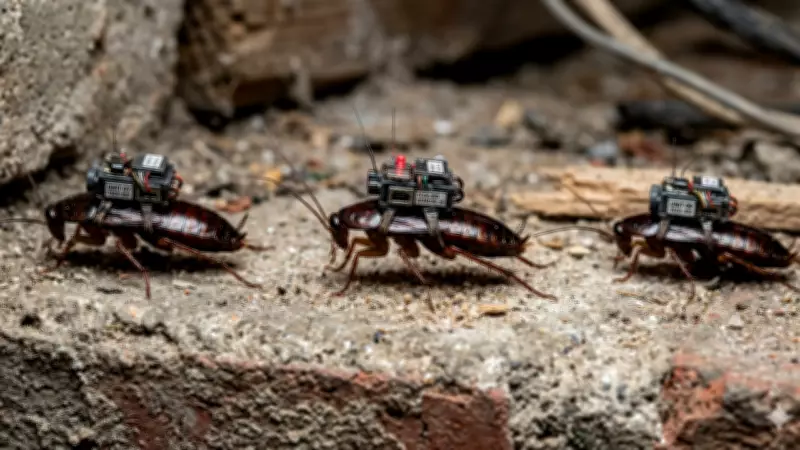
Cyborg Cockroaches: A Sci-Fi Concept Turned Reality
Although the concept might sound like something straight out of a science fiction novel, it is rapidly being adopted by the scientific community. Researchers have begun creating 'cyborg cockroaches,' which are live insects equipped with tiny electronic 'backpacks.' These devices enable the cockroaches to navigate areas that are too small or hazardous for humans, opening up new possibilities in industrial applications.
How Cyborg Cockroaches Function in Pipeline Inspection
The invention behind cyborg cockroaches is based on a simple yet effective idea: combining biology with technology. Scientists attach lightweight electronic systems to the cockroaches, which often include sensors, cameras, and communication devices. By connecting these systems to the insect's nervous system, researchers can control its movement remotely from a distance.
A study published on PubMed on autonomous cockroach bio-robots reveals that these insects can crawl through dark, tight pipelines while transmitting data in real time. This is achieved by fitting them with micro-cameras and onboard sensors. Consequently, they are ideal for inspecting pipelines where visibility is poor and access is challenging.

Why Cockroaches Are Perfect for Leak Detection
Despite their unpopular reputation, cockroaches have evolved into highly effective survivors. Scientists are now harnessing these characteristics for practical purposes. Research indicates that cockroach-based bio-robots offer "better flexibility, larger payload, and stronger endurance" compared to artificial robots of similar size. These traits are crucial when navigating long, winding pipelines that may contain corrosion, debris, or structural irregularities.
Their small size allows them to reach places that even the most sophisticated mechanical robots struggle to access. Additionally, studies from the University of California have shown that cockroaches can move swiftly while squeezing through incredibly narrow spaces, inspiring earlier robotic designs.
The Technology Behind the Miniature Rigs
Cyborg cockroaches carry 'miniature rigs,' which are essentially small sensor packages. These may include:
- Micro-cameras for visual examination
- Gas or thermal sensors to detect leaks
- Data transmission modules for communication
In some systems, advanced navigational tools like distance sensors and inertial measurement units (IMUs) help track orientation and movement. These tools are highly beneficial for precise navigation.
Furthermore, research published on ScienceDirect discusses navigation systems that assist insects in avoiding obstacles and recognizing human presence in emergencies. This technology can be adapted for pipeline environments, where detecting anomalies is critically important.
Future Potential of Bio-Robotics in Industry
Beyond pipeline inspection, cyborg cockroaches have far-reaching implications. These hybrid systems could revolutionize how we handle dangerous situations, from environmental monitoring to search and rescue operations.
According to a research team at Osaka University, these systems successfully navigate tough terrain by blending millions of years of evolution with modern technology. Their ability to operate in areas inaccessible to humans or machines opens up new opportunities across various industries, including urban infrastructure and oil and gas.
As the technology advances, swarms of these bio-robots might collaborate to cover large areas efficiently, providing real-time data with minimal risk and cost. Ultimately, the common cockroach, often viewed as a pest, may soon play a vital role in maintaining critical infrastructure. Researchers are not just solving technical problems but reshaping our understanding of robotics by integrating engineering with nature.






