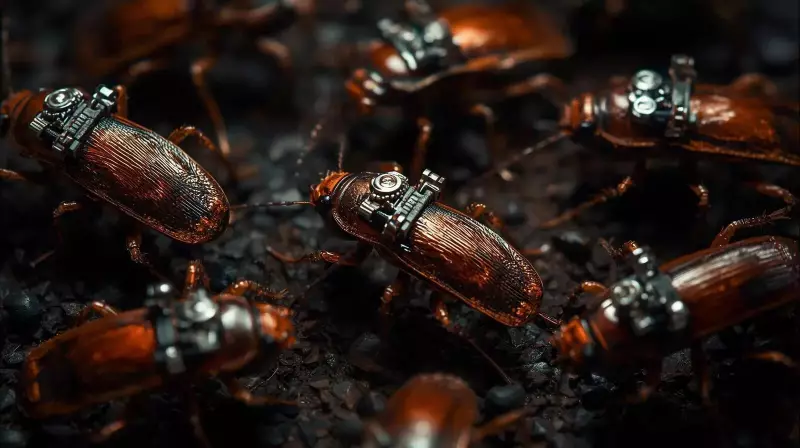
For decades, futuristic visions of espionage involved sleek flying vehicles and advanced robotics. However, a groundbreaking development in Germany is shifting the focus from the skies to the ground, employing one of nature's most resilient creatures: the cockroach. A startup named SWARM Biotactics, founded in 2024, is pioneering the use of live insects as mobile intelligence-gathering tools, blending biology with technology for defence and humanitarian purposes.
The Practical Logic Behind Insect Espionage
The concept moves beyond science fiction into a realm of stark practicality. Traditional drones and ground robots often fail in complex, confined environments like collapsed buildings, tight gaps, or damaged infrastructure. Human rescue or reconnaissance teams face significant risks in these zones. Cockroaches, however, are evolutionarily engineered for chaos. They can survive extreme pressure, navigate through darkness and debris, and access spaces that are otherwise unreachable.
SWARM Biotactics views these insects not as replacements for existing technology but as a complementary asset. They are designed to gather critical snippets of information—visual, auditory, or environmental—from the heart of inaccessible areas. This innovation comes at a pivotal time as Germany reassesses its defence and intelligence capabilities, influenced by the ongoing war in Ukraine and the evolving nature of modern threats.

How the Cyborg Cockroach Technology Works
The core of SWARM's technology lies in a small electronic 'backpack' fitted onto the insect. This pack contains a pair of electrodes connected to the cockroach's antennae. Cockroaches naturally use their antennae to sense and navigate around obstacles. By sending precise electrical impulses through these electrodes, operators can hijack this innate navigation system to steer the insect along desired paths.
Initially, this can be done via remote control, piloting the bug like an RC vehicle. However, the company is developing advanced algorithms for autonomous control. This would enable the management of an entire swarm of bio-hybrid units, each carrying different payloads in its backpack. Potential equipment includes:
- Miniature cameras and microphones for surveillance.
- GPS modules for location tracking.
- Communication relays for data transmission.
- Environmental sensors for detecting gases or structural integrity.
Why the Madagascar Hissing Cockroach is the Ideal Candidate
Not every cockroach is suited for this mission. SWARM Biotactics likely focuses on species like the Madagascar hissing cockroach for several compelling reasons. This insect is notably large and robust, capable of carrying the extra weight of the tech backpack without being immobilised. It is also famously resilient and has been a subject of scientific study for decades.
This extensive biological familiarity reduces uncertainty for engineers. It allows them to design systems that work in harmony with the insect's natural movements and behaviours, guiding rather than forcing its actions. The aim is a seamless integration of living organism and machine.
Beyond the Battlefield: Potential in Disaster Response
While much of the dialogue surrounds defence applications, SWARM also highlights significant potential in disaster response. In the aftermath of earthquakes, building collapses, or industrial accidents, these cyborg cockroaches could be deployed as first responders. They could crawl through rubble to locate survivors by detecting body heat, sound, or movement, or to assess structural damage, providing crucial data to human rescue teams and potentially saving lives.
The trajectory of such technology, however, is often shaped by its initial funding sources. Military investment typically drives early-stage development, even if civilian and humanitarian applications are proposed concurrently. Whether these insect scouts become common tools for firefighters and rescue workers remains to be seen.

This fusion of biotactics and electronics marks a fascinating and somewhat unsettling new chapter in surveillance and rescue technology. As SWARM Biotactics advances its research, the world watches to see if these guided insects will become a standard asset in securing dangerous spaces and responding to human crises.