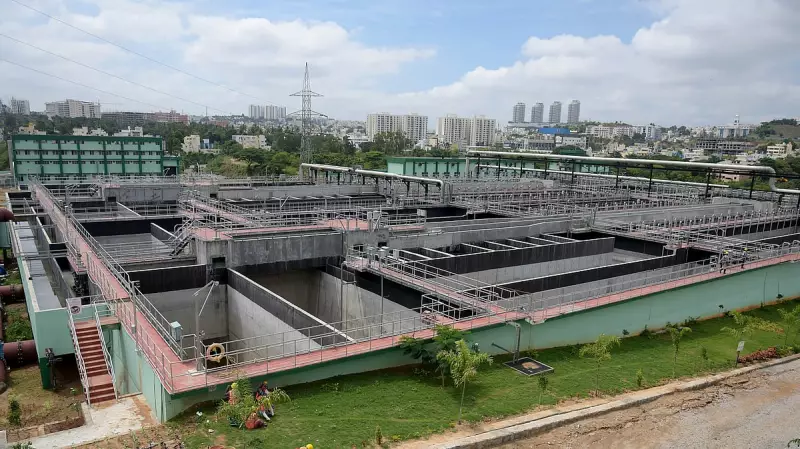
In a significant step towards sustainable urban water management, a unique sewage treatment plant (STP) that operates primarily using gravity was officially unveiled in Bengaluru. The launch took place at the Environment Management Policy Research Institute, showcasing a technology designed to tackle wastewater challenges with reduced energy dependency.
How the Gravity-Powered Technology Works
The newly presented STP boasts a capacity to treat up to 10,000 litres of sewage every day. Its core innovation lies in a four-stage operating process that cleverly exploits the natural force of gravity to move and purify water. This method transforms raw sewage into secondary treated water, which is suitable for various non-potable uses like gardening, flushing, and industrial cooling.
The process begins with preliminary screening and settling, where large solids are removed. Subsequent stages involve biological treatment where microorganisms break down organic matter, all facilitated by gravity-driven flow. This design significantly cuts down on the electrical energy typically required to run pumps in conventional STPs, making it a greener alternative.

The Space Constraint: A Key Limitation
While the technology presents a promising, low-energy solution for sewage treatment, experts acknowledge a primary limitation. The major constraint is its substantial requirement for space. The gravity-flow system needs a larger footprint compared to some compact, energy-intensive models. This makes it potentially more suitable for institutional campuses, large residential complexes, or peri-urban areas where land is more readily available than a consistent and costly power supply.
Implications for Bengaluru and Beyond
The unveiling on 06 January 2026 marks a critical moment for Bengaluru, a city perennially grappling with water stress and lake pollution. Deploying such gravity-based STPs in strategic locations could alleviate pressure on the city's water bodies by enabling localised wastewater recycling. The treated water can replenish groundwater or be used for horticulture, reducing the demand for fresh potable water.
This innovation from the Environment Management Policy Research Institute highlights a shift towards nature-based solutions in urban infrastructure. It proves that sometimes, the most effective technology leverages fundamental natural principles. The success of this model could inspire similar adaptations across other Indian cities facing water scarcity, promoting a more sustainable and resilient approach to urban water management.