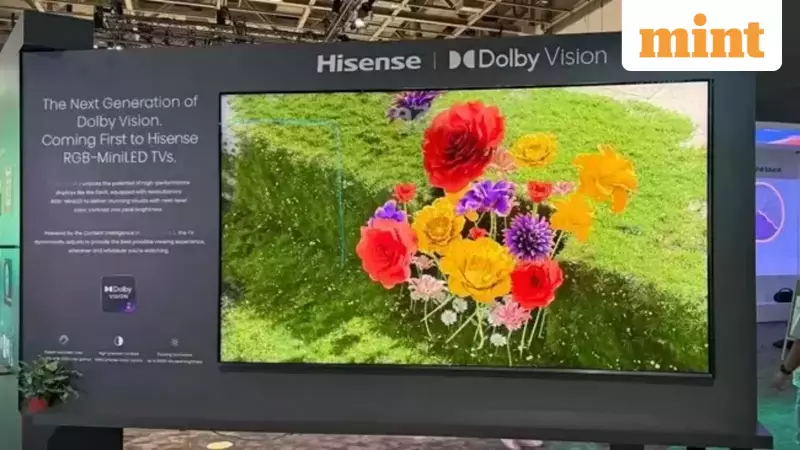
The future of home entertainment just got a major upgrade at CES 2026. Dolby Laboratories has moved its next-generation visual technology, Dolby Vision 2, from the realm of promises to concrete product plans. The company has officially confirmed the first three television brands that will bring this enhanced high dynamic range (HDR) format to living rooms, with a rollout strategy that includes both built-in support and future firmware updates.
First Wave of Dolby Vision 2 TVs Announced
At the global tech showcase in Las Vegas, Dolby verified that Hisense, TCL, and TP Vision's Philips will be the pioneering brands for Dolby Vision 2 in 2026. This announcement is significant for consumers, especially in value-conscious markets like India, as Dolby Vision has become a recognizable benchmark for premium picture quality in everyday viewing.
The upgrade path, however, will not be uniform across all models. For shoppers eyeing the latest sets, understanding the specifics is crucial.

Hisense had previously been linked to the format at IFA 2025, but CES brought clarity. The company's 2026 lineup of RGB mini LED TVs, specifically the UX, UR9, and UR8 series, will support Dolby Vision 2. Buyers considering Hisense's more affordable mini LED models should note that support for these is planned to arrive later via a software update, making it essential to verify the exact series before purchase.
TCL is adopting a similar update-led approach. According to Dolby, the brand's 2026 X QD mini LED TV series and C series TVs are slated to receive Dolby Vision 2 capabilities through a future firmware update, not necessarily at launch.
Philips, under TP Vision, will integrate the technology into its 2026 OLED lineup. The confirmed models set to feature Dolby Vision 2 are the OLED811, OLED911, and OLED951.
The key takeaway for consumers is that Dolby Vision 2 support is highly model-specific, and for certain ranges, the feature hinges on a firmware update arriving after the TV has been purchased.
What Dolby Vision 2 Aims to Fix for Viewers
Dolby Vision 2 is not a minor tweak but a substantial upgrade designed to tackle common viewer complaints, particularly with streaming content. The technology introduces new features aimed at delivering a more consistent and immersive experience.
Precision Black is engineered to revolutionise how dark scenes are rendered. It aims to produce deeper, more natural blacks without sacrificing shadow detail, which often turns into a grey, hazy mess on current screens. This is Dolby's direct response to the widespread frustration viewers express when scenes in popular streaming shows appear "too dark to see."
Another innovative feature, Light Sense, addresses the challenge of ambient lighting. It adapts the picture dynamically to the room's lighting conditions, ensuring the image retains its integrity and punch whether you're watching in a pitch-dark room or with daylight or lamps on.
Furthermore, Dolby is targeting live sports enthusiasts with optimised processing for motion and picture handling. This aims to reduce the judder or overly artificial, soap-opera-effect look that can plague sports broadcasts, depending on a TV's settings.
Two Tiers and The Content Question
Dolby is introducing a two-tier system: Dolby Vision 2 and Dolby Vision 2 Max. The Max tier includes a more advanced image engine and a feature called Authentic Motion. This tool is designed to reduce judder while preserving natural-looking motion, offering creators more control instead of relying solely on a TV's often-clunky motion interpolation settings.
A critical detail yet to be clarified is which of the announced TV models will support the standard tier and which will qualify for Dolby Vision 2 Max. This distinction will become a key differentiator on spec sheets as brands finalise their marketing.

Of course, a new format is only as good as the content available. At CES, Peacock was announced as the first streaming service to support Dolby Vision 2, alongside next-generation Dolby Atmos audio. While this is a positive start, the speed at which major global and Indian streaming platforms adopt the format will ultimately determine how quickly it becomes a part of daily viewing habits.
Practical Advice for 2026 TV Buyers in India
With Dolby Vision 2 transitioning from showfloor demos to retail products, Indian consumers planning a TV upgrade this year should be strategic. The rollout will be staggered and inconsistent across different brands and even within model lineups.
The most practical advice is straightforward: do your homework on the exact model number. Before committing to a purchase, confirm whether Dolby Vision 2 support is available out-of-the-box or is promised via a future update. Additionally, keep an eye on whether the model supports the standard version or the enhanced Dolby Vision 2 Max, as this could significantly impact the long-term viewing experience and value of your investment.