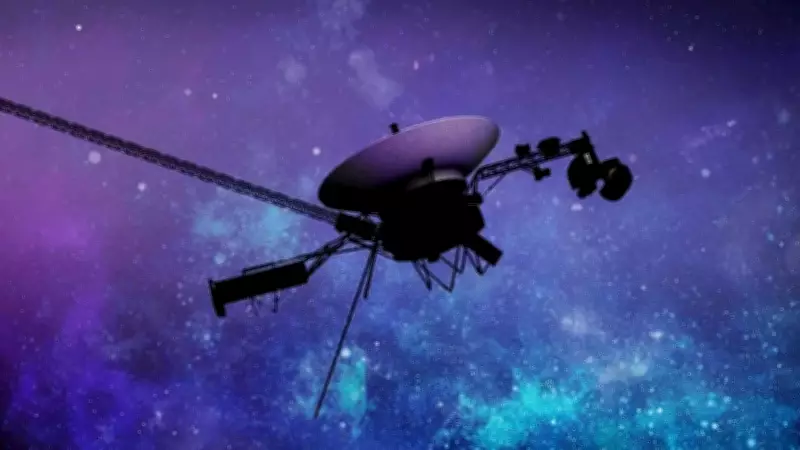
NASA's Voyager 1 Battles Power Emergency in Deep Space
Launched nearly half a century ago, NASA's Voyager 1 continues its epic journey through the cosmos, now positioned over 15 billion miles from Earth. As the farthest human-made object ever to travel, this pioneering spacecraft represents a monumental achievement in space exploration. However, Voyager 1 is currently confronting a critical power-related emergency that threatens its ongoing mission.
The Looming Power Crisis
The spacecraft relies on radioisotope thermoelectric generators for power, but these systems are losing approximately four watts of energy each year. This gradual depletion poses a severe risk: without sufficient power, Voyager 1 will automatically enter fault-protection mode, rendering it inoperable for future scientific observations. To prevent this outcome, engineers at the Jet Propulsion Laboratory (JPL) have initiated a strategic shutdown of non-essential systems.
This careful power management plan aims to sustain communication and data reception from the edges of our solar system throughout the 2030s. By prioritizing critical functions, JPL hopes to extend the spacecraft's operational life despite the diminishing energy supply.

Sacrificing Science for Survival
In a significant move to conserve power, NASA deactivated the Low-energy Charged Particles (LECP) experiment on April 17th, 2026. This instrument had provided nearly continuous measurements of ions, electrons, and cosmic rays from beyond the heliosphere since Voyager 1's launch in 1977. The decision to turn off the LECP was based on a pre-established hierarchy of priorities, designed to keep the most vital systems functioning as long as possible.
Disabling this major science instrument is expected to enhance the spacecraft's power output and reduce the risk of system failures during its prolonged flight through the interstellar medium. This step underscores the challenging trade-offs required to maintain Voyager 1's mission in the face of escalating power constraints.
The 'Big Bang' Strategy for Longevity
NASA has unveiled an ambitious plan dubbed 'the Big Bang' to further prolong the operational lifespan of the Voyager spacecraft. This strategy involves the coordinated reconfiguration of several onboard components to optimize the use of remaining power. A key objective is to keep the spacecraft sufficiently warm to prevent fuel line freeze-up, a critical concern in the frigid depths of space.
The agency plans to test this innovative procedure on Voyager 2 in May and June 2026. If successful, the same solution will be applied to Voyager 1 no earlier than July of that year. There is even a slight possibility that previously deactivated instruments could be reactivated, offering a glimmer of hope for renewed scientific capabilities.
Communication Challenges at Extreme Distances
Operating Voyager 1 presents unique logistical hurdles due to its immense distance from Earth—approximately 23 light hours away. Each command sent from Ground Control takes nearly a full day to reach the probe, with an additional day required for confirmation of receipt. This communication delay eliminates the possibility of real-time troubleshooting, forcing mission managers to exercise exceptional caution and foresight in their operations.
Despite these challenges, Voyager 1 maintains contact with Earth through its two remaining operational science instruments: the plasma wave subsystems and the magnetometer. These tools continue to transmit groundbreaking scientific data from regions of space never before explored by human-designed spacecraft, providing invaluable insights into the interstellar environment.
As NASA engineers work tirelessly to navigate this power crisis, Voyager 1's enduring mission stands as a testament to human ingenuity and the relentless pursuit of knowledge in the final frontier.