Massive Solar Storm Strikes Earth: A Rare Celestial Event Explained for UPSC Aspirants
In a remarkable astronomical occurrence, Earth experienced the most intense solar radiation storm in over two decades during January 18-19, 2026. This powerful event, originating from our Sun, has captured global attention and holds significant relevance for UPSC current affairs preparation, particularly in the Science and Technology domain.
The Solar Phenomenon: Understanding the Storm's Origin
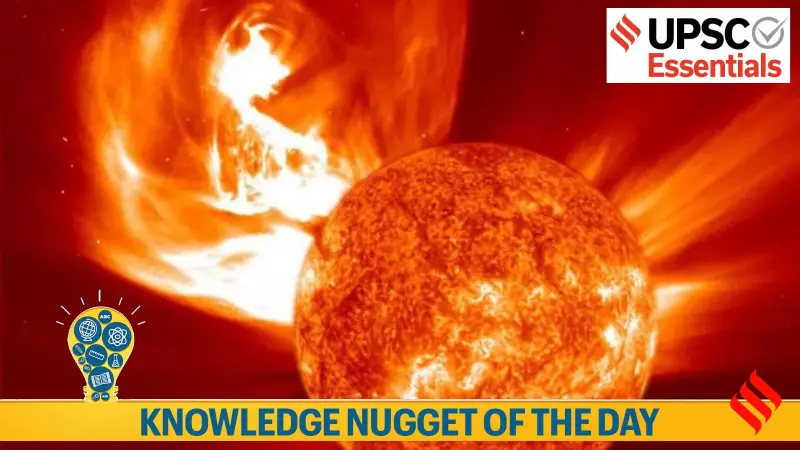
The Sun, far from being a placid celestial body, functions as a dynamic magnetic dynamo. Solar storms emerge from complex interactions within its magnetic field. When sunspots—those darker, magnetically intense regions on the solar surface—become unstable, they can trigger massive energy releases known as solar flares and coronal mass ejections (CMEs).
This recent event featured an X-class solar flare, the strongest category observed in 23 years. The accompanying CME, a colossal cloud of charged particles, traveled rapidly toward Earth, colliding with our planet's magnetic field at approximately 2:38 PM EST on January 19. The Space Weather Prediction Centre (SWPC) classified this geomagnetic disturbance as G4 or "severe" on their intensity scale.

Solar Cycles and Maximum Activity Periods
The Sun operates on an approximately 11-year activity cycle, and we are currently navigating through the more active phase of Solar Cycle 25. During this solar maximum period, when the Sun's magnetic field undergoes polarity reversal, solar activity intensifies significantly. This phase results in more frequent and powerful solar flares and CMEs, providing scientists with valuable opportunities to study our star's behavior.
India's contribution to solar research has been substantial with the launch of Aditya-L1, the nation's first dedicated solar mission. This spacecraft aims to expand our understanding of solar phenomena and their effects on space weather, making this topic particularly relevant for competitive examinations.
Earthly Consequences: The Impact of Severe Solar Storms
Such intense solar events can have profound effects on our technological infrastructure and space operations:
- Disruption of radio communications and satellite operations
- Potential interference with power grids and electrical systems
- Increased radiation exposure risks for astronauts aboard the International Space Station
- Potential hazards for airline passengers on polar routes
Historical precedents demonstrate the seriousness of these events. The Halloween storms of 2003, for instance, caused power outages in Sweden and damaged electrical equipment in South Africa. In response to the recent storm, the SWPC has alerted various organizations including airlines, NASA, and emergency management authorities to prepare for potential impacts.
Auroral Displays: Nature's Light Show
One of the most visually spectacular outcomes of this solar storm has been the appearance of auroras far beyond their typical polar regions. These stunning light displays, known as Aurora Borealis in the northern hemisphere and Aurora Australis in the southern hemisphere, were reported across unusual locations including California, Greenland, Austria, and Germany.
The formation of auroras involves a fascinating interaction between charged solar particles and Earth's magnetosphere. As solar winds approach our planet, Earth's magnetic field deflects most particles, but some become trapped and travel along magnetic field lines toward the poles. When these particles collide with atmospheric gases, they produce brilliant colored lights—green from oxygen interactions, and shades of blue and purple from nitrogen collisions.
UPSC Relevance and Examination Context
This topic holds particular importance for civil services aspirants as solar phenomena have appeared in previous UPSC examinations. Understanding the mechanisms behind solar storms, their classification, and their potential impacts on Earth's systems forms crucial knowledge for both prelims and mains examinations.

The recent event underscores the importance of space weather monitoring and research initiatives like India's Aditya-L1 mission. As we continue through Solar Cycle 25's active phase, such events may become more frequent, making this knowledge increasingly relevant for policymakers, scientists, and competitive examination candidates alike.
For comprehensive preparation, aspirants should focus on understanding solar cycles, different types of solar emissions, their effects on Earth's systems, and India's contributions to solar research through missions like Aditya-L1.