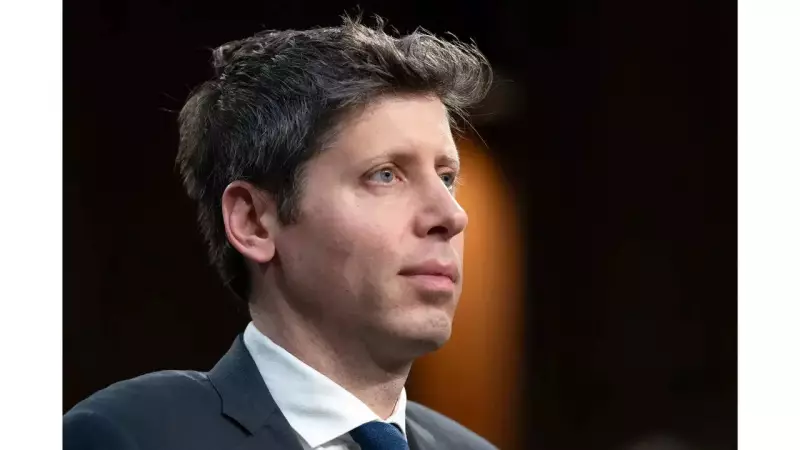
In a candid revelation, OpenAI's chief executive Sam Altman has stated he has absolutely no personal interest in leading a publicly traded company. This surprising admission comes even as he acknowledges the practical necessity for the creator of ChatGPT to eventually go public to secure the massive capital required for its ambitious growth.
"0% Excited": Altman's Candid Take on a Potential IPO
Speaking on the 'Big Technology Podcast,' Altman did not mince words about his personal feelings. "Am I excited to be a public company CEO? 0%," he declared. His sentiments about OpenAI itself becoming a public entity were mixed. "Am I excited for OpenAI to be a public company? In some ways, I am, and in some ways I think it'd be really annoying," Altman noted.
Despite his personal reluctance, the CEO is clear-eyed about the financial realities. He confirmed that OpenAI "needs a lot of capital" and will inevitably "cross all of the shareholder limits and stuff at some point." Altman sees a silver lining, appreciating that public markets allow broader participation in value creation. He also pointed out that by traditional standards, OpenAI would be "very late to go public."

The Road to a Trillion-Dollar Listing: What We Know
Founded in 2015 by Sam Altman and eleven others, OpenAI's trajectory changed dramatically with the 2022 launch of ChatGPT, which now boasts approximately 800 million weekly users. The company's staggering growth is underscored by deals worth around $1 trillion with tech giants like Oracle, Nvidia, and AMD.
Signs are increasingly pointing toward an eventual Initial Public Offering (IPO). A Reuters report in October indicated that OpenAI is considering filing with securities regulators as early as the second half of 2026. The company is reportedly in early discussions with a valuation of about $830 billion, with some estimates reaching as high as $1 trillion.
According to reports, Chief Financial Officer Sarah Friar is targeting a stock market listing in 2027, with a potential IPO filing in late 2026. This move is seen as critical for raising the enormous funds needed to compete at the highest level of the global artificial intelligence industry.
Restructuring and the AI Arms Race
OpenAI's journey to this point involved a significant corporate overhaul. Originally established as a nonprofit, the company completed a major restructuring in October, transforming into a more traditional for-profit entity. As part of this change, the controlling nonprofit received a $130 billion stake, while Microsoft's share was reduced to 27%. The restructuring also expanded Microsoft's research access and permitted OpenAI to partner with other cloud-computing providers.
The intense competition in the AI sector was highlighted earlier this month when Altman issued an internal "code red" memo following Google's rapid launch of its Gemini 3 model. This directive called for an eight-week focus on accelerating OpenAI's core projects, pausing other initiatives like advertising and e-commerce expansion.
This strategic shift appears to be yielding results. OpenAI recently launched its new GPT-5.2 model and followed it with a fresh image-generation model to rival Google's offerings. While OpenAI's apps CEO Fidji Simo stated the release was not a direct response to Gemini 3, she acknowledged that the extra resources from the "code red" period helped speed up the launch timeline.
As OpenAI navigates the complex path between its foundational ideals, astronomical capital needs, and a CEO personally averse to the public market spotlight, its journey toward a potential historic IPO remains one of the most closely watched narratives in global technology.