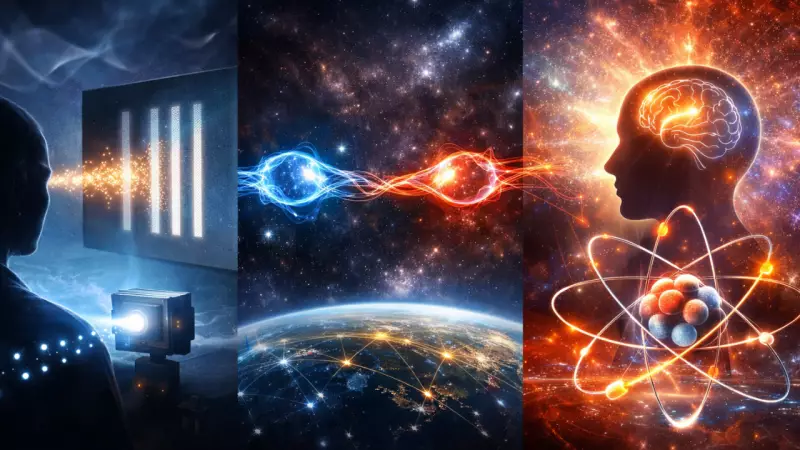
Quantum Physics Uncovers the Mind's Hidden Role in Reality
Quantum physics began as a quest to understand matter's fundamental nature. Scientists explored the smallest building blocks of existence, expecting to find predictable mechanical laws. Instead, they encountered something unexpected. The observer, once considered a passive witness, emerged as an active participant in shaping outcomes. This revelation continues to unsettle researchers today.
Here are three groundbreaking discoveries from quantum physics that quietly transformed our understanding of the mind's power. These findings don't rely on mystical explanations. They present scientific evidence that challenges conventional thinking about consciousness and reality.
1. Observation Changes Reality Itself
The observer effect stands as one of quantum physics' most famous discoveries. At the quantum level, particles behave differently when someone watches them. Consider the classic double-slit experiment. Subatomic particles act like waves when unobserved, existing in multiple states simultaneously. They spread out and explore various possibilities.

Everything changes when measurement occurs. The moment scientists observe these particles, they collapse into a single defined state. They stop behaving like waves and start acting like particles. This phenomenon carries profound implications.
Reality doesn't fully determine what it is until observation happens. This doesn't mean our minds magically create reality at will. It suggests conscious observation plays a crucial role in shaping outcomes. At microscopic scales, the universe appears responsive rather than fixed.
From a psychological perspective, this echoes familiar experiences. What we consistently focus on becomes more concrete in our lives. Attention isn't neutral. It selects specific possibilities and brings them into sharper focus. Quantum physics didn't prove manifestation theories. It did dismantle the idea that reality exists completely independent of awareness.
2. Everything Connects Beneath the Surface
Quantum entanglement revealed something even more astonishing. When two particles become entangled, they maintain a mysterious connection regardless of distance. Change one particle's state, and the other responds instantly. This interaction happens faster than light speed.
Albert Einstein famously called this "spooky action at a distance." The discovery shattered conventional beliefs about separation. Scientists previously thought the universe functioned through isolated parts interacting locally. Quantum entanglement showed separation isn't as real as it appears.
This finding destabilizes the concept of isolation. It reframes reality as deeply interconnected at fundamental levels. So where does the mind fit into this picture?
If reality itself is interconnected beneath appearances, then thoughts and emotions may not be as private as we assume. This doesn't mean thoughts travel through space like radio signals. It suggests influence might operate through connection rather than force.
Human beings intuitively recognize this phenomenon. Moods spread through rooms without explanation. Intentions shift group dynamics subtly. Presence changes conversations without spoken words. Quantum physics didn't explain these social experiences scientifically. It removed the certainty that separation is absolute. The universe appears relational at its core.
3. Matter Is Mostly Empty Space and Energy
Perhaps the most humbling discovery concerns matter's true nature. Solid objects aren't actually solid in the way we perceive them. Atoms consist mostly of empty space. What feels firm to our senses represents energy fields interacting, not dense material blocks.
At the deepest level, everything reduces to vibration, probability, and energy patterns. This realization completely reframes the mind-body relationship. Thoughts aren't "nothing." They represent energy events within the nervous system.
Emotions manifest as chemical and electrical patterns. Attention corresponds to measurable brain activity. When everything in the universe represents energy in motion, the mind no longer stands outside physical reality. It becomes part of the same energetic field.

This doesn't mean thoughts instantly reshape the external world. It does suggest inner states influence physical systems more than older scientific models allowed. Stress demonstrably alters immune function. Belief shapes perception directly. Expectation changes behavior, which subsequently alters outcomes.
What Quantum Physics Allows Us to Question
Quantum science makes no claims that positive thinking cures diseases or bends reality on command. What it accomplished was removing old certainties about consciousness's irrelevance. The mind isn't merely a byproduct of physical processes. Observation isn't passive. Reality doesn't fully fix itself until interaction occurs.
These ideas quietly support what psychology, neuroscience, and lived experience have long suggested. How we perceive the world shapes how we live within it. Quantum physics opened doors to questions that traditional science once considered off-limits. It continues to challenge our understanding of where mind ends and matter begins.