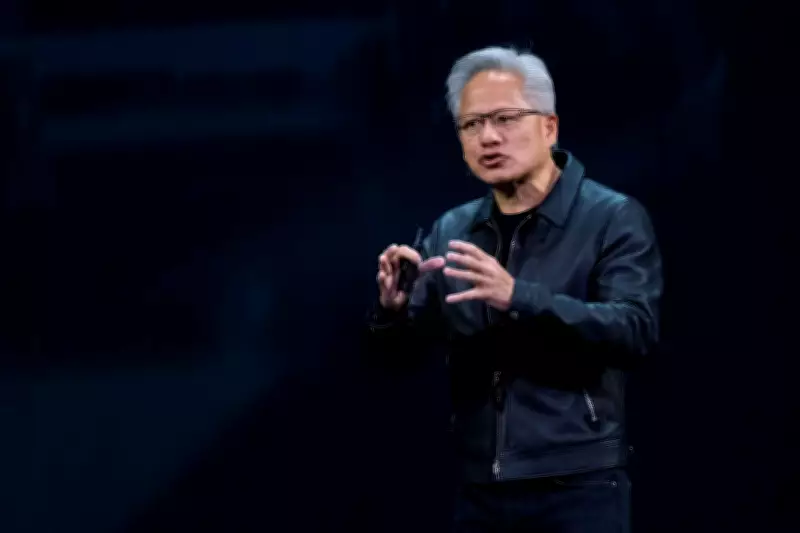
Nvidia CEO Jensen Huang Sounds Alarm on US AI Leadership Amid China Rivalry
In a recent appearance on the Dwarkesh Podcast, Nvidia CEO Jensen Huang delivered a pointed warning to the United States, emphasizing that collaboration with China, rather than confrontation, serves American interests. Huang argued that restrictive policies could undermine the US's technological edge in artificial intelligence, a sector where Nvidia plays a pivotal role.
The Threat from Huawei's CANN Framework and DeepSeek's Advancements
Huang highlighted a critical vulnerability: the potential migration from Nvidia's proprietary CUDA software to Huawei's CANN framework. This shift, he explained, threatens to sever the software-hardware dependency that underpins American AI dominance. Concurrently, US lawmakers are considering placing DeepSeek, a Chinese AI model, on the entity list for export controls, a move Huang views with concern.
"We have got to acknowledge that most of the advances in AI came out of algorithm advances, not just the raw hardware," Huang stated. "Now, if most advances came from algorithms and computer science and programming, tell me that their army of AI researchers is not their fundamental advantage. We see it. DeepSeek is not an inconsequential advance. The day that DeepSeek comes out on Huawei first, that is a horrible outcome for our nation."

Open-Source Models and Hardware Optimization Risks
When questioned about DeepSeek's open-source nature and its potential to run on any system, Huang presented a counter-scenario. He warned that if the model becomes optimized for Huawei's architecture, it could disadvantage American tech stacks. "Suppose it doesn’t. Suppose it’s optimized for Huawei, suppose it’s optimized for their architecture. It would put ours at a disadvantage," he explained. Huang contrasted this with a more favorable situation where AI models perform best on American hardware, underscoring the strategic importance of maintaining technological superiority.
Critique of US Export Policies and Market Concessions
Huang expressed frustration with US regulations that limit Nvidia's ability to compete globally, particularly in China. He argued that such policies effectively cede vast market segments to competitors. "Why is it that we don’t come up with a regulation that’s more balanced so that Nvidia can win around the world instead of giving up the world?" he questioned. "The chip industry is part of the American ecosystem. It’s part of American technology leadership. It’s part of the AI ecosystem. It’s part of AI leadership. Why is it that your policy, your philosophy, leads to the United States giving up a vast part of the world’s market?"
Rejecting a "Loser Mindset" in American Industry
Emphatically rejecting the notion that the US is destined to lose in global AI competition, Huang stressed the importance of innovation and ecosystem loyalty. "We have to keep innovating and, as you probably know, our share is growing, not decreasing," he asserted. Huang compared computing ecosystems to entrenched platforms like x86 and ARM, which are difficult to replace due to high switching costs and user inertia.
"The premise that even if we compete in China, that we’re going to lose that market anyways… You’re not talking to somebody who woke up a loser. That loser attitude, that loser premise makes no sense to me. We’re not a car. Computing is not like that. These ecosystems are hard to replace. It costs an enormous amount of time and energy, and most people don’t want to do it. So it’s our job to continue to nurture that ecosystem, to keep advancing the technology so that we can compete in the marketplace."
Huang concluded by reaffirming his confidence in American industry, stating, "Conceding a marketplace based on the premise you described, I simply can’t acknowledge that. It makes no sense. Because I don’t think the United States is a loser. Our industry is not a loser. That losing proposition, that losing mindset, makes no sense to me."