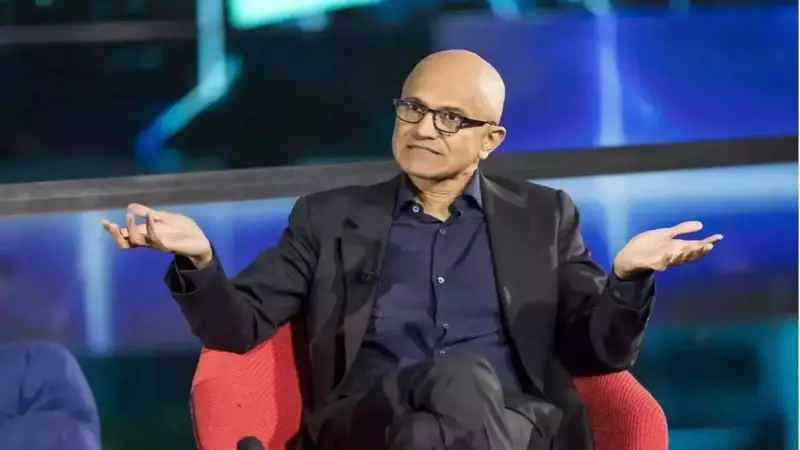
In a dramatic internal move, Microsoft's Chief Executive Officer Satya Nadella has presented his top leadership with a blunt ultimatum: either fully commit to the company's all-consuming push into artificial intelligence or prepare to leave. This stark message, revealed through internal documents and employee interviews obtained by Business Insider, underscores the existential stakes Nadella attaches to this technological shift.
The "Adapt or Exit" Mandate from the Top
Satya Nadella views AI as both the greatest threat and the single biggest opportunity for Microsoft in decades. This perspective is now directly shaping the company's leadership landscape. According to reports, Nadella is personally conducting one-on-one conversations with senior executives to secure their commitment to the demanding workload ahead or to facilitate their departure from the company.
"Satya is pushing on intensity and urgency," one Microsoft executive told Business Insider. The pressure is reportedly forcing long-time company veterans to make a crucial decision about their future. "You've gotta be asking yourself how much longer you want to do this," the executive added, highlighting the significant personal toll of the transformation.

Organizational Overhaul for an AI-Centric Future
This aggressive push has triggered sweeping changes within Microsoft's structure. Nadella recently promoted Judson Althoff to CEO of Microsoft's commercial business. An internal memo stated this move was explicitly designed to free up Nadella's own time for a "laser focus" on technical work, including datacenter expansion, systems architecture, and AI product innovation.
This represents a notable shift in Nadella's leadership style. For the first time during his tenure as CEO, he did not deliver the keynote at Microsoft's recent Ignite conference, ceding the spotlight to Althoff. Furthermore, Nadella has initiated weekly "AI accelerator" meetings that deliberately include lower-level technical employees instead of just executives, fostering what insiders call a "messy and chaotic" environment to break away from top-down management.
Emphasising this cultural shift, Nadella wrote in a Teams channel for corporate vice presidents and above that leaders must "work and act like ICs (Individual Contributors) in our own orgs," prioritising hands-on technical work over pure people management.
Executive Shake-up and the Fear of Irrelevance
More leadership changes appear to be on the horizon. Three executives indicated that Rajesh Jha, the long-time head of Office and Windows, has been considering retirement, though the excitement around AI's potential may influence his final decision. Should Jha depart, LinkedIn CEO Ryan Roslansky is seen as a potential successor. Roslansky's role was recently expanded to include oversight of Outlook, Word, Excel, PowerPoint, and the Microsoft 365 Copilot application.
The driving force behind this frantic pace is Nadella's profound fear of Microsoft becoming irrelevant. At a September employee town hall, he confessed to being "haunted" by the collapse of Digital Equipment Corporation, a once-dominant computer maker that failed to adapt. "Some of the biggest businesses we've built might not be as relevant going forward," Nadella warned, acknowledging that even Microsoft's most profitable products face an uncertain future in the AI era.
This transformation has come with significant human cost. Earlier this year, Microsoft laid off roughly 6,000 employees in May, followed by an additional 9,000 in July. Nadella described these cuts as part of a painful but necessary process of "unlearning and learning." Reports from The Verge indicate employee morale has hit record lows, with staff describing the company atmosphere as "markedly different, colder, more rigid."
Asha Sharma, Microsoft's CoreAI product president who joined in 2024, explained that Nadella's new "production function" concept uses AI to radically alter how products are made and delivered. She noted that AI breaks the traditional link between software development inputs and outputs, with AI agents now acting as scalable units that can generate software without a linear increase in engineering hours.

Despite the internal turmoil, Nadella remains defiantly optimistic about Microsoft's internal capabilities. "I chuckle a bit each time someone sends me a note about talking to a friend at an AI start-up, about how differently they're working," he wrote internally. "The reality is that this work is also happening right here at Microsoft under our noses!"