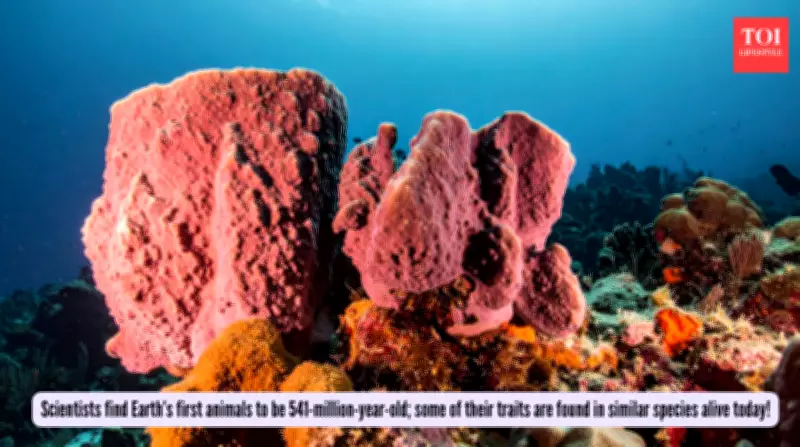
MIT Scientists Uncover Earth's Earliest Animal Life: 541-Million-Year-Old Sea Sponges
In a groundbreaking discovery that rewrites our understanding of life's origins, researchers from the Massachusetts Institute of Technology have identified what they believe to be Earth's first animals. The findings, published in the prestigious Proceedings of the National Academy of Sciences (PNAS), reveal that soft-bodied sea sponges existed over 541 million years ago, predating the famous Cambrian explosion by millions of years.
Chemical Fossils Reveal Ancient Secrets
The MIT team analyzed Precambrian rock samples, searching for "chemical fossils" - molecular remnants that survive long after physical remains have vanished. Their focus was on steranes, compounds derived from sterols found in eukaryotic cell membranes. These sterols are crucial indicators of complex life forms with nucleus-containing cells.
"We don't know exactly what these organisms would have looked like back then, but they absolutely would have lived in the ocean, they would have been soft-bodied, and we presume they didn't have a silica skeleton," explained Roger Summons, a lead researcher on the project. "These ancient creatures inhabited murky seas long before the diversification of life during the Cambrian period."

The Smoking Gun: 30-Carbon Steranes
A key discovery was the presence of steranes with an uncommon 30-carbon structure, a molecular signature typically associated with demosponges - a type of sea sponge still common in oceans today. "It's very unusual to find a sterol with 30 carbons," noted team member Lubna Shawar, highlighting the significance of this finding.
To confirm their hypothesis, researchers conducted laboratory simulations, subjecting sterols from living sponges to conditions mimicking geological burial over millions of years. The resulting chemical signatures matched exactly with those found in the ancient rock samples.
Three Lines of Converging Evidence
The study presents a compelling case built on three mutually supporting lines of evidence:
- Chemical analysis of 541-million-year-old rock samples
- Comparison with sterols from modern sea sponges
- Laboratory simulations recreating geological processes
"These special steranes were there all along," Shawar explained. "It took asking the right questions to seek them out and to really understand their meaning and from where they come."
Roger Summons emphasized the strength of this multi-pronged approach: "It's a combination of what's in the rock, what's in the sponge, and what you can make in a chemistry laboratory. You've got three supportive, mutually agreeing lines of evidence, pointing to these sponges being among the earliest animals on Earth."
Implications for Evolutionary Timelines
This discovery pushes the origins of animal life deeper into the Precambrian era than previously documented. Demosponges produce these distinctive steranes through specific enzymes not found in bacteria or other early life forms, making them reliable biomarkers for tracing animal evolution.
The research suggests that complex life may have emerged earlier than current evolutionary models propose, potentially requiring revisions to established timelines of life's development on our planet. These findings offer new insights into how chemical soups in ancient oceans eventually gave rise to the first multicellular organisms, providing crucial clues about our own biological origins.