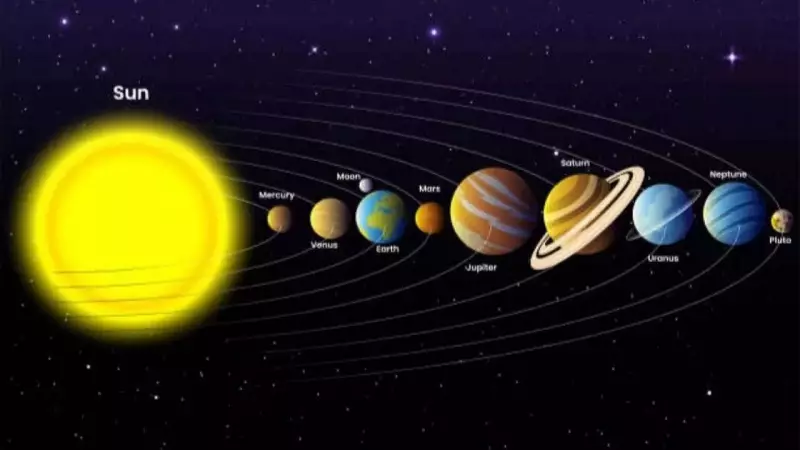
Planetary Time: How a Day Varies Dramatically Across Our Solar System
While Earth's familiar 24-hour cycle defines our daily lives, the concept of a "day" transforms dramatically when we look beyond our planet. Across the vast expanse of our solar system, planetary rotation creates astonishing variations in day length—from worlds where a single rotation takes longer than an entire year to gas giants spinning at breathtaking speeds that compress time into mere hours.
The Solar System's Fastest Spinner: Jupiter's Remarkable 9-Hour Day
The undisputed champion of rapid rotation in our solar system is Jupiter, the largest planet. A complete day on Jupiter lasts only about 9 hours and 56 minutes, making it the fastest-spinning planet astronomers have observed. This means Jupiter completes nearly two full rotations in the time Earth manages just one, creating a compressed temporal experience that challenges our earthly perceptions of time.
What makes Jupiter's rapid spin particularly fascinating is its sheer size contradiction. Despite being the solar system's largest planet—with a diameter approximately 11 times that of Earth—Jupiter maintains this astonishing rotational velocity. The planet's equatorial bulge, visible even through telescopes, provides visual evidence of how its rapid rotation distorts its shape, creating a noticeable flattening at the poles and expansion at the equator.

Why Jupiter Rotates So Rapidly: The Science Behind the Speed
According to NASA scientists and astronomical research, Jupiter's exceptional rotational speed stems from several interconnected factors that distinguish it from rocky planets like Earth or Mars.
Gaseous Composition: Unlike terrestrial planets with solid surfaces, Jupiter consists primarily of hydrogen and helium gases. This fluid composition allows the planet to rotate with significantly less internal friction and resistance, enabling it to maintain higher rotational velocities without the structural constraints that limit rocky worlds.
Angular Momentum Preservation: During Jupiter's formation approximately 4.5 billion years ago, the planet retained an enormous amount of angular momentum from the collapsing cloud of gas and dust that created it. This conserved momentum has persisted through the ages, driving Jupiter's rapid spin that continues essentially unchanged today.
Gravitational Influence: Jupiter's immense gravitational field—approximately 2.5 times stronger than Earth's—helps stabilize and maintain its rapid rotation. This gravitational dominance prevents external forces from significantly slowing the planet's spin over astronomical timescales.
Comparative Planetary Time: How Other Worlds Measure Their Days
While Jupiter holds the record for shortest day, examining other planets reveals the diverse temporal landscapes across our solar system:
- Saturn: Following Jupiter, Saturn completes a rotation in just over 10 hours, making it another rapidly spinning gas giant
- Earth: Our familiar 24-hour day serves as the baseline for human timekeeping
- Mars: The Red Planet's day lasts approximately 24 hours and 37 minutes, remarkably similar to Earth's rotation period
- Venus: In a dramatic reversal, Venus takes 243 Earth days to complete one rotation—making its day longer than its year of 225 Earth days
Cosmic Implications: What Jupiter Teaches Us About Time and Planetary Formation
Jupiter's compressed day challenges our fundamental understanding of time as an absolute constant. Instead, it demonstrates that temporal experience varies dramatically based on location within the cosmos. This rapid rotation doesn't indicate a "slow" world—rather, Jupiter's quick spin generates some of the solar system's most extreme atmospheric phenomena, including its famous Great Red Spot and powerful jet streams.

By studying Jupiter's rotational characteristics, scientists gain crucial insights into planetary formation processes, conservation of angular momentum in cosmic bodies, and how initial conditions during a planet's creation can determine its behavior billions of years later. These variations in planetary time serve as natural laboratories for understanding fundamental physical principles operating on cosmic scales.
This exploration of planetary rotation reminds us that our Earth-centric experience of time represents just one possibility among countless variations throughout the universe. As we continue studying worlds like Jupiter, we expand our understanding of how celestial bodies evolve and function across the vast tapestry of cosmic time.