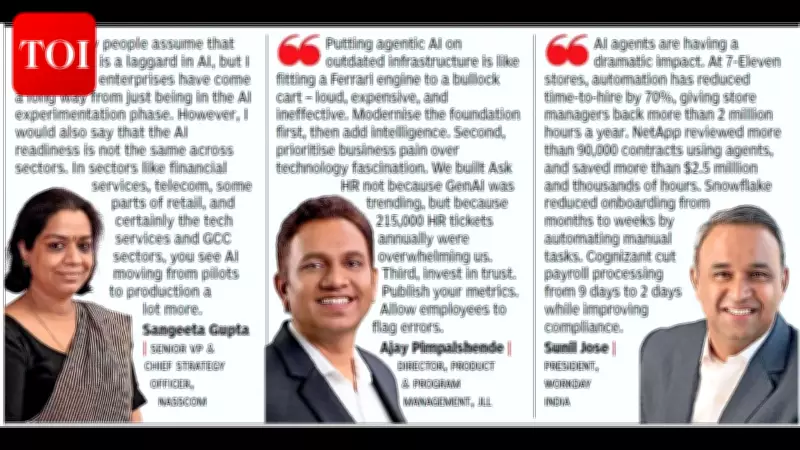
The conversation around AI in enterprises has decisively moved beyond experimentation. The new challenge is no longer how to build an impressive proof-of-concept, but how to deploy agentic AI at scale in ways that are reliable, governed and capable of delivering measurable business outcomes.
That was the central theme of a discussion held last week.
At a Tipping Point
“We are at a fascinating tipping point,” said Sunil Jose, head of India for Workday, the $10-billion cloud-based enterprise software company. “We are moving past that initial awe of what AI can do, and now we are facing the real enterprise world: How do we make AI scale? How do we make it matter?”

Scaling AI, he explained, is not just about deploying technology, but about embedding intelligence directly into the fabric of business operations to drive measurable value. “The agents need to be part of the system-of-record, not a bolt-on chatbot sitting on the side. And we need to govern AI agents like digital employees with clear identities, permissions, and audit trails,” he said.
Foundation First
Sangeeta Gupta, senior VP & chief strategy officer at Nasscom, emphasized that enterprises must get their data foundation right, their governance right, and their workforce ready before they can expect pilot, siloed AI use-cases to truly scale and impact the business.
Ajay Pimpalshende, director of product & program management at JLL, the commercial real estate and investment management company, was equally emphatic on that point. Enterprises must, he said, “unify before they amplify”. “Don't start with AI. Start with the foundation. AI amplifies what you provide. Fragmented foundation equals fragmented AI. My honest advice for every CXO: don't AI-enable your legacy systems,” he warned.
JLL spent nearly 18 months building a unified platform across more than 80 countries before aggressively deploying AI capabilities. The company has since built several AI-powered applications, including an ‘Ask HR’ assistant that handles employee queries ranging from leave balances to transfer policies. Previously, such requests generated more than 200,000 HR service tickets annually. The new system now allows HR teams to focus on coaching, workforce planning and strategic work.
Another application allows leaders to query HR and workforce data using natural language rather than building custom reports. “If my CHRO from Chicago wants to understand what’s happening in Singapore – attrition rate, number of hires, compensation – she can simply query it in natural language and immediately get a report,” Pimpalshende said. JLL has also deployed AI-enabled recruitment systems that have reduced hiring cycles from 52 days to less than 30 days.
Strong Near-Term Impact Areas
Some of the strongest near-term impact of AI agents, Jose noted, is emerging in finance, HR, workforce planning, procurement and employee services. In finance, agents can automate reconciliations, audit preparation and planning activities. In HR, they can answer routine employee queries, manage staffing changes, and streamline recruitment. In procurement, they can support sourcing, contract reviews and invoice matching.
Managing Risks of Autonomy
But as AI agents gain greater autonomy, governance becomes a central concern. How do enterprises allow AI agents to act independently while ensuring compliance, auditability and accountability? Jose argued that enterprises must treat AI agents like digital employees. “Enforce the least privileged access so agents can only act on data that is relevant to the user,” he said. And every action must remain traceable. “We need to execute agent actions under identification of the human they represent, so every step is traceable back to the person, a policy and a business justification,” he said.
For heavy judgement decisions, keeping humans in the loop is very important – even as agents are used to prepare all the work and bring together the right context.

Gupta echoed that view, arguing that agentic AI is about augmented decision-making, not about replacement of humans. “You could take a risk-based approach. You may have a marketing use case where you let an agent work autonomously, within boundaries that you define. But there may be higher-risk use cases that need audit trails, explainability and grievance mechanisms. In credit, healthcare, public services, you need a human who's really responsible for the end outcomes,” she said.
It is also important, she added, to ensure transparency is built into the design. So that when AI is used, users will know the precise role it's playing, the data it is relying on, and what they can challenge and escalate.