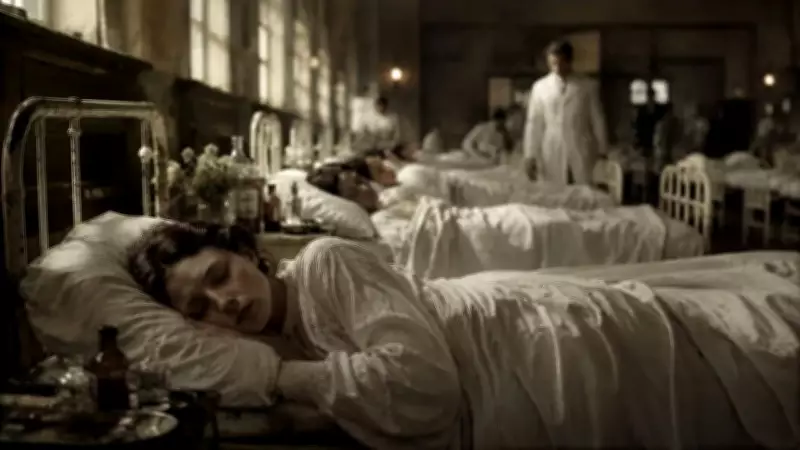
In the years following the First World War, hospitals across Europe and beyond began documenting an unusual condition that defied known infections or neurological disorders. Patients arrived with symptoms resembling a severe flu, then gradually slipped into a state that families struggled to describe—neither fully unconscious nor completely awake. Some slept for days, while others remained motionless for hours with eyes open, as if their attention had vanished. Physicians named it encephalitis lethargica, a term that sounded almost poetic but described a grim reality. This disease moved through medical records like an unfinished sentence, leaving behind fragments, inconsistent notes, and countless unanswered questions.
Unexplained Sleep States During the 1918–1920 Pandemic
The timing of the outbreak complicated efforts to understand it. While influenza swept across continents between 1918 and 1920, this other condition appeared in parallel, sometimes in the same hospital wards. Initially, the overlap suggested a connection, but the pattern never remained consistent. Some patients with encephalitis lethargica had recently recovered from flu-like symptoms, while others had no clear prior infection. In certain hospitals, the illness surged in clusters and then faded without warning. According to ASM, by the early 1920s, reports from different countries described varying presentations, as if the disease changed its behavior depending on location.
Early clinicians often focused on sleep, but not in a simple sense. People were not merely tired; they entered prolonged states where waking and dreaming blurred. Some could be briefly roused, only to drift back into stillness. Cases included patients sitting upright for hours without speaking, while others showed bursts of agitation before collapsing into deep lethargy. Families often described losing the person twice: first mentally, then physically. One patient might deteriorate rapidly over days, while another lingered in a half-state for months. In a few cases, the condition shifted rather than fading, leaving survivors altered in ways that defied existing neurological categories.

Long-Term Neurological Effects
Even after the initial outbreaks subsided, the story did not end cleanly. Some survivors did not return to their previous lives. Months or years later, a second phase often emerged, marked by stiffness in movement, slowed responses, and changes in facial expression—features later recognized as Parkinsonian. Not everyone developed these symptoms, but the pattern was consistent enough to be noted across case records from different countries. There were also reports of psychological changes, with families describing abrupt personality shifts. Whether these resulted from the disease itself or the long aftermath of severe brain inflammation was difficult to determine.
The Long Debate Over an Infectious Origin
At the time, medical thinking repeatedly returned to infection. The overlap with influenza made that connection hard to ignore. Some physicians suspected the flu virus triggered brain inflammation, even if not directly responsible for the full syndrome. Others looked further back, pointing to similar neurological oddities in the late 19th century, suggesting a recurring infectious agent that reappeared under certain conditions but never behaved predictably. Later laboratory work, decades after the original epidemic, attempted to extract clues from preserved tissue samples. Results did not settle the debate. Some analyses suggested viral traces fitting an enterovirus model—a group including pathogens that affect the nervous system—while other studies found nothing consistent. Autoimmune explanations also emerged, but a condition so widespread across continents and social groups did not easily fit a purely self-directed immune response, as such disorders were understood at the time.

A Disease That Refuses to Sit Still in History
What makes encephalitis lethargica difficult to classify is not just the uncertainty about its cause, but the instability of its identity. It does not present as a single syndrome with fixed symptoms. Instead, it behaves like a cluster of overlapping neurological disturbances that occasionally move together. This has left historians and neurologists with an awkward legacy. The original epidemic is over, at least in any recognizable form, yet isolated cases continued to appear sporadically in subsequent decades—rare enough to avoid forming a pattern, but persistent enough to resist dismissal. By the early 21st century, only a handful of documented cases had been reported worldwide over many decades. Even then, they did not always match historical descriptions precisely, raising further questions about whether the original condition was one disease or several that happened to converge in time.