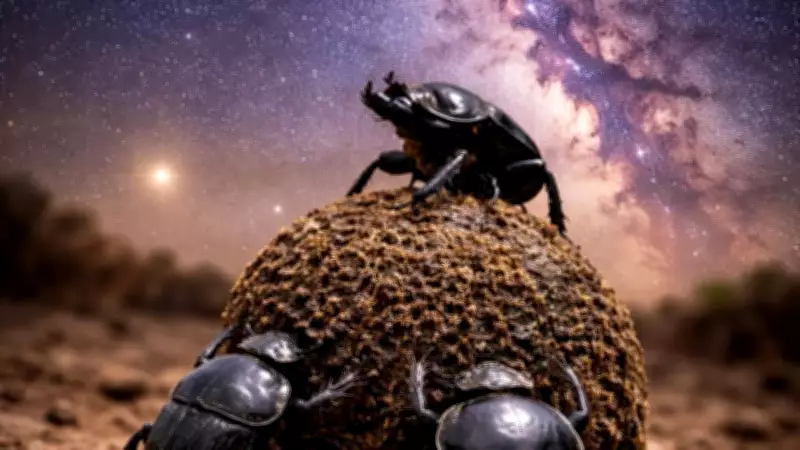
Dung Beetles Navigate by the Milky Way, a Groundbreaking Discovery
It might seem improbable that a tiny insect could navigate using the night sky, but dung beetles have proven capable of this remarkable feat. Research confirms that these beetles rely on the star patterns of the Milky Way galaxy for orientation, making them the first animals known to employ such sophisticated celestial navigation. This finding illuminates the complex ways animals move through their environments, driven by survival needs.
Straight-Line Navigation: A Key to Avoiding Competition
Dung beetles operate in highly competitive settings. Upon finding animal droppings, they quickly form dung balls and roll them away from the pile to evade rivals. This behavior is critical for survival, as many beetles congregate at dung sites, often stealing balls rather than creating new ones. Following a straight path is essential; losing a ball forces a beetle to start over, wasting precious time and energy and jeopardizing reproductive success.
Daytime Navigation: Utilizing the Sun and Polarized Light
During the day, dung beetles use the Sun as a primary guide. They detect polarization patterns of light around the Sun, which are invisible to humans, through specialized receptors in their eyes. This ability allows them to maintain a consistent angle, ensuring straight-line movement even in bright conditions.

Nighttime Navigation: The Role of Celestial Cues
In darkness, daytime methods become ineffective. Moonlight offers an unreliable alternative due to its variability and weak signals. Scientists investigated this by studying nocturnal species like Scarabaeus satyrus. They observed that beetles continued to orient correctly in straight lines even without moonlight, suggesting other navigation mechanisms. Experiments revealed that under full starry skies or in planetariums with artificial stars, beetles navigated accurately. Notably, they remained oriented when exposed only to the bright stripe of the Milky Way, confirming its use as a celestial guide.
The Crucial Importance of Sky Visibility
To validate these findings, researchers conducted further tests by blocking the beetles' view of the sky. They placed tiny caps on the insects' heads to prevent detection of celestial light. In these cases, the beetles lost their ability to move in straight lines, becoming erratic. This demonstrated that visual cues from the sky are essential for navigation and that beetles do not rely solely on terrestrial clues.
This discovery underscores the incredible adaptability and intelligence of dung beetles, offering insights into animal behavior and navigation strategies in the natural world.