In an era where Artificial Intelligence (AI) can generate complex code in seconds, a fundamental question arises about the future role of computer scientists. This pressing query was put forward to Turing Award laureate Professor Jeffrey D Ullman during a recent interaction in Bengaluru. The celebrated academic, whose textbooks are pillars of engineering curricula globally, provided a reassuring and nuanced perspective on the evolving synergy between human intellect and machine capability.
The Enduring Role of the Human Builder
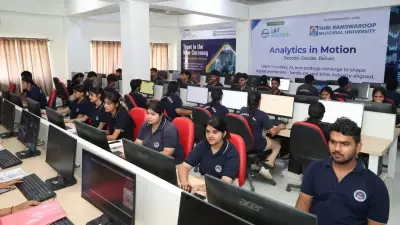
Addressing an audience at the RV College of Engineering, where he was invited for a session organized in association with the Prayoga Institute of Education Research, Ullman firmly stated that computer scientists will remain essential builders. He described the emerging practice of 'vibe coding', where a developer prompts a Large Language Model (LLM) to write code and then uses another AI tool to debug it. However, he emphasized that the critical human input cannot be automated.
'Someone has to say not only what is worth writing code about or what application is worth doing, but at least roughly how to do it,' Ullman asserted. The professor, honored with the prestigious Turing Award by the Association for Computing Machinery in 2020, highlighted that conceptualization and decision-making are inherently human domains that AI currently supplements rather than supplants.

Balancing Foundational Skills and AI Tools in Education
A significant part of Ullman's discussion focused on the crucial need to reform computer science education to prepare students for this new reality. He stressed that teaching fundamental coding principles remains non-negotiable. Students must initially learn to write code themselves to grasp core concepts.
His proposed curriculum model advocates for a balanced approach. 'In the course, introduce a programme where you are going to write the code yourself. But later, probably in the sophomore or junior year, you are going to have to take a course in live programming. There, instead of being forbidden from using an LLM, you are forbidden from writing code yourself,' he explained. This method ensures students master the basics before learning to effectively orchestrate and manage AI-powered coding processes.
AI's Impact on Careers and the Future of Data
Ullman also tackled the looming career concerns within the tech industry. He noted that AI-enabled prompting can potentially double a programmer's output. 'Do we need only half as many programmers? Or is there still 2X more work that becomes economically feasible? Well, I don't know,' he admitted, pointing to the uncertain but significant economic shift underway.
Looking at the technical horizon, he raised a pivotal question about the future improvement of LLMs. 'The other question out there is whether LLMs are going to get any better or whether they already are based on data. There is pretty much nothing left on the internet for them to consume,' he observed. This scarcity of new training data poses a challenge, leaving the community to hope for novel data sources or algorithmic breakthroughs to drive the next leap in AI capability.
AI in Research: A Call for Quality over Quantity
When asked about the pervasive use of AI in academic research, Ullman expressed concern over the metric-driven culture. 'People are putting far too much stock in publication count rather than value,' he stated. While acknowledging the difficulty in changing this trend, he suggested a tangible solution: universities should evaluate researchers based on the quality of their best papers rather than the sheer volume of their publications.
Finally, defining the relationship between humans and AI, Ullman positioned the technology firmly as a collaborator. Drawing a parallel to an everyday tool, he said, 'I think it is very likely that we will see it as a collaborator. Google is a collaborator, right? When you don't know something, you just go, you Google it. It has become a referral.' His vision frames AI not as a competitor vying for jobs, but as an advanced instrument that amplifies human potential, with the computer scientist's core role as a visionary builder remaining more vital than ever.