Ishan Kishan's Triumphant Return to Form
In the high-stakes arena of international cricket, opportunities seldom arrive as neatly packaged gifts. More frequently, they emerge from the shadows of another player's misfortune, demanding immediate and decisive action. This precise scenario unfolded for Ishan Kishan during India's recent T20I series against New Zealand, where he transformed a chance opening into an undeniable claim for the wicketkeeper's role in the upcoming T20 World Cup.
From Audition to Ascendancy
Tilak Varma's unfortunate injury created the vacancy that Kishan needed to reassert his credentials. Given the full series to demonstrate his capabilities, the left-handed dynamo approached each innings with palpable intent and purpose. His campaign began with explosive authority in Raipur, where he blazed 76 runs from just 32 deliveries, immediately setting an aggressive tone for the series.
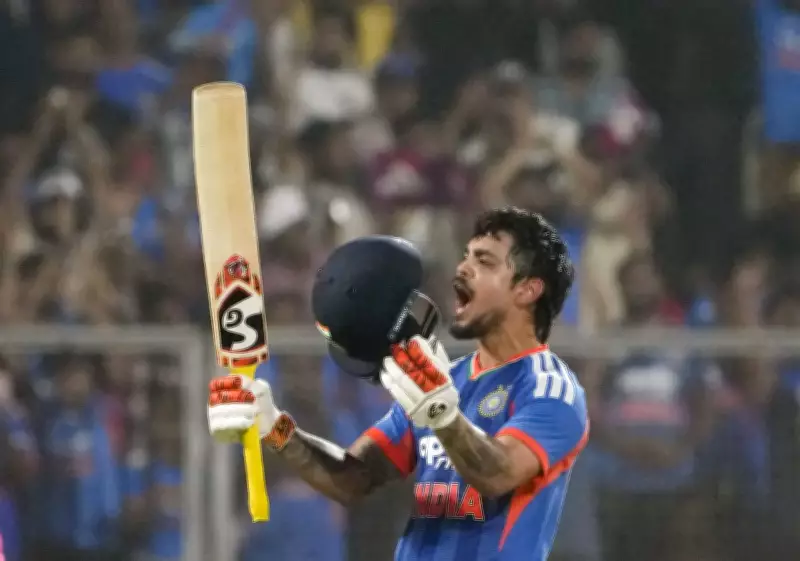
The momentum continued unabated in Guwahati, where Kishan contributed a rapid-fire 28 off 13 balls. However, the true masterpiece arrived at Thiruvananthapuram's Greenfield International Stadium. On what many consider Sanju Samson's home turf, Kishan unleashed a breathtaking assault, hammering 103 runs from a mere 43 deliveries to register his maiden T20I century.

By the conclusion of the New Zealand series, Kishan had transcended the phase of mere auditioning. He had firmly established himself as the primary contender for India's wicketkeeping position, demonstrating both consistency and match-winning capability when the team needed it most.
The Tactical Conundrum of Left-Handed Dominance
Kishan's ascendancy does present India's think tank with an intriguing tactical puzzle. Should he open alongside Abhishek Sharma at the T20 World Cup, India would field two left-handed batters at the top of the order. This configuration could potentially result in six left-handers among the top eight positions if Tilak Varma, Rinku Singh, Shivam Dube, and Axar Patel all feature in the playing eleven.
On theoretical grounds, such batting imbalance might raise strategic eyebrows. Yet in practical terms, Kishan has created such substantial daylight between himself and his competitors that this consideration appears secondary. His decisive approach in a format where hesitation proves fatal has become his most formidable weapon, rendering theoretical concerns about left-right combinations less significant.
The Wicketkeeping Rotation and Its Symbolism
The series against New Zealand featured a carefully orchestrated wicketkeeping rotation that carried significant symbolic weight. Captain Suryakumar Yadav confirmed the arrangement was predetermined, with Samson scheduled to keep in three matches and Kishan in two. However, in elite sports, optics often speak louder than pre-match plans.
Kishan's assumption of the gloves during the fifth T20I in Thiruvananthapuram, despite an imperfect performance behind the stumps that fortunately didn't cost India, contrasted sharply with Samson's struggles at the crease. The Kerala batsman's dismissal after a brief six-ball stay presented a familiar tableau of disappointment—the bat dangling helplessly, eyes searching for answers that continue to elude him.
Technical Contrasts Between Contenders
A deeper examination reveals fundamental technical divergences between the two wicketkeeper-batters. Where modern batting greats like Rohit Sharma employ subtle forward triggers to maintain access to both sides of the field, Samson has developed a concerning technical pattern. His footwork increasingly drifts backward and toward the leg side, effectively preparing him to dominate only one half of the field.
This leg-side dominant setup works splendidly against deliveries on his pads, which he can whip or flick with authority. However, when confronted with balls directed at middle and off stump, Samson finds himself chasing deliveries, his bat fishing outside his body's line. This technical flaw erodes his timing, compromises his control, and brings the outside edge into frequent play.

Lockie Ferguson's dismissal of Samson in the series exemplified this vulnerability perfectly. The New Zealand speedster required no elaborate deception—just extra pace, a hard length, and a ball angled outside off stump. Samson, already committed to his leg-side movement, attempted to manufacture a shot and produced the predictable outcome: a thick edge and a despondent return to the pavilion.
The Statistical Narrative
The numbers from the series paint a starkly contrasting picture. Samson managed just 46 runs across five games, a disappointing return that fails to justify continued selection at the highest level. Meanwhile, Kishan has surged forward with such conviction and productivity that he has effectively secured the wicketkeeper's position for the T20 World Cup.
Kishan's journey from substitute to standout performer underscores cricket's unforgiving nature, where one player's setback becomes another's springboard to success. His comprehensive dominance with the bat, combined with serviceable glovework, has positioned him as India's premier choice behind the stumps as the team prepares for global competition.