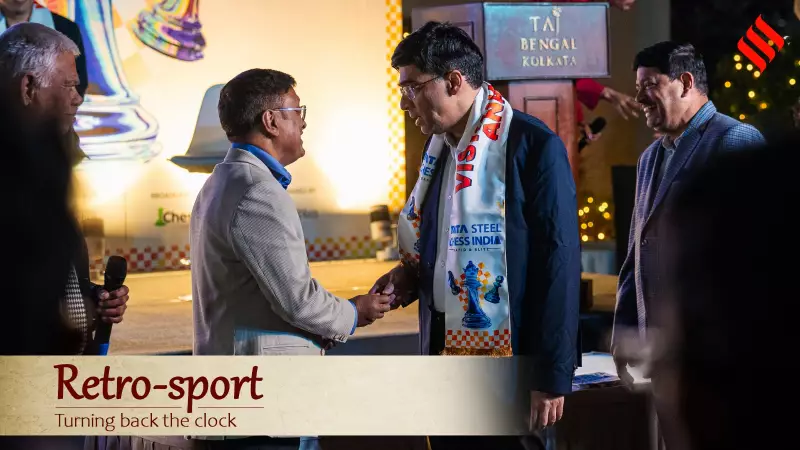
Historic Chess Duel: When Kolkata's Russian House Hosted India's First Two Grandmasters
The current generation of Indian chess stars—D Gukesh, Arjun Erigaisi, and R Praggnanandhaa—dominates global tournaments, with fans eagerly anticipating their matchups as potential future World Championship duels. However, this fascination with elite Indian chess battles isn't new. It traces back to a historic encounter thirty-four years ago that captivated a nation.
The 1992 Goodricke Tournament: A Pivotal Moment in Indian Chess
In January 1992, Calcutta's Gorky Sadan, known as the Russian House, buzzed with anticipation during the Goodricke tournament. This event was a highlight in India's sparse chess calendar at the time. The air was thick with excitement as two chess pioneers prepared to face each other across the board.
Viswanathan Anand, already a comet in the chess world, had become India's first Grandmaster five years earlier. He had shattered decades-old barriers, sweeping national, Asian, and World Junior titles. By 1992, Anand was priming for an unprecedented quest: winning the Chess World Championship, a dream no Indian had dared to pursue before.

Across from him sat Dibyendu Barua, Calcutta's own local hero and India's newly minted second Grandmaster. Barua recalls those days with clarity, noting that he and Anand had once raced for that first GM title, sharing rooms and team events. However, by 1991-92, Anand had surged ahead significantly. "He was on a different level altogether," Barua remembers.
The Organizers' Strategic Pairing and Massive Public Interest
The Goodricke tournament followed a Swiss format, where pairings were based on scores and results. Sensing a historic opportunity, the organizers deliberately paired Anand and Barua when both had similar points. "The organizers didn't want to take any chance," Barua recalls with a chuckle. "That was the only time we could have faced each other, and they forced the pairing."
The announcement generated instant buzz. The previous evening, Doordarshan broadcasted: "Tomorrow, Anand and Barua, India's first and second Grandmasters, will play each other." This publicity sparked tremendous interest in Kolkata. "You won't believe the popularity in Kolkata back then," Barua says. "Anand had a huge following, and people turned up in numbers just to see us together."
Unprecedented Crowds and Manual Demonstration Boards
On the day of the game, Gorky Sadan was packed to capacity. A crowd swelled outside the Russian House compound, unable to gain entry. This was the early 1990s, an era without live streams or electronic display boards in India—those innovations would arrive only a decade later.
Spectators relied on manual demonstration boards, where a person physically moved pieces on large wall-mounted sets for the audience. The demand to follow the game was so intense that organizers had to set up multiple boards. "You won't believe it," Barua recalls. "They had to put up not one, but six or seven demonstration boards all around the hall. So many people had come. They all wanted to follow every move."
The Game Itself: A Technical Grind Ending in a Draw
Over the board, the tussle was genuine and intense. Barua, trailing 2.0-3.0 in their head-to-head match-up, proved more than a match that day. With Anand playing white, they engaged in a Queen's Gambit Declined Slav. The game stretched for 56 moves, featuring three pawns and a bishop-knight each, resulting in a technical grind. Ultimately, they shook hands and shared the point.
This match marked the last time India's first Grandmaster ever played against the country's second Grandmaster in a competitive setting. Anand went on to tie for first place with David Norwood in the tournament. He later revolutionized chess in India, winning the World Championship five times across different formats and cementing his legacy during an era of turmoil.
Legacy and Continuation of the Chess Tradition
Barua's path diverged from Anand's, though he didn't reach the same dizzying heights. His legacy in Bengal remains enduring. Today, he is a pillar of the chess community—an organizer, coach, and academy director nurturing the next wave of talent.

When contemporary stars like Gukesh, Praggnanandhaa, and Erigaisi face off, it's crucial to remember that this isn't the beginning of India's chess story. It's a continuation of a narrative that started decades ago in a packed hall in Calcutta. There, two pioneers demonstrated to a nation just how profoundly a chess game could resonate, laying the foundation for today's dominant wave of Indian chess excellence.