The Telangana Legislative Assembly on Saturday took a significant step by passing a bill to abolish the long-standing two-child policy for candidates contesting elections to rural local bodies. This norm, which previously barred individuals with more than two children from running in gram panchayat polls, has been officially removed.
Reversing a Three-Decade-Old Population Policy
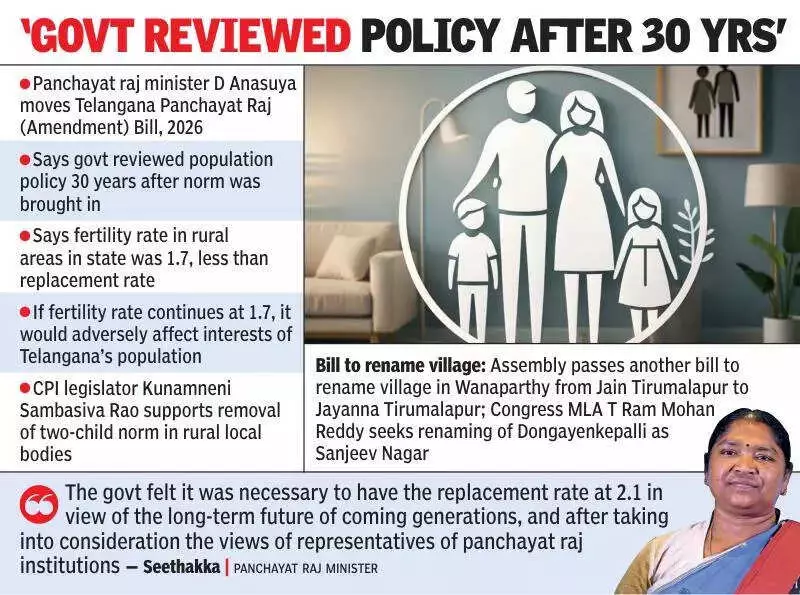
Panchayat Raj Minister D Anasuya, popularly known as Seethakka, presented the Telangana Panchayat Raj (Amendment) Bill, 2026 in the House. She explained that the two-child norm was originally introduced in 1994 as a population control strategy. Its goal was to tackle issues like food security, unemployment, and poverty that were linked to the population explosion witnessed in the 1980s and 1990s.
The minister stated that the government conducted a review of this population policy thirty years after its implementation. The review revealed a crucial statistic: the fertility rate in Telangana's rural areas has dropped to 1.7, which is below the replacement rate. She warned that if this trend continues, it could negatively impact the future interests of the state's population.
The Rationale Behind the Repeal
Minister Seethakka elaborated that the government now believes it is necessary to aim for a replacement fertility rate of 2.1 for the long-term well-being of future generations. This decision was made after considering the views of representatives from panchayat raj institutions. She pointed out that many citizens are now opting for smaller families, and a sharp decline in population growth could lead to undesirable consequences. The amendment to the Telangana Panchayat Raj Act, 2018 is specifically proposed to improve the declining fertility rate.
The minister also mentioned a High Court directive to conduct local body elections within a set timeframe. Following this, an ordinance was issued, and gram panchayat polls were held. The bill passed by the Assembly now replaces that ordinance.
Mixed Reactions and Broader Concerns
The move did not receive unanimous support. BJP MLA K Venkata Ramana Reddy urged the state government to reconsider, arguing that India's growing population requires control. He contended that unchecked growth would strain land and resources and that removing the norm "just for political convenience" was not advisable.
In contrast, CPI legislator Kunamneni Sambasiva Rao supported the removal but called for a balanced approach. He advocated for regular studies on population growth and gender ratios to inform future law changes, ensuring the population neither plummets nor skyrockets.
In her reply, Minister Seethakka acknowledged the suggestions but highlighted a larger geopolitical concern. She stated that there is a threat of political domination by northern states over the south, as southern states have successfully implemented population control measures. She noted that the previous government had removed the norm for municipalities but not for gram panchayats. The current government, after consulting elected representatives and rural citizens, decided to remove it entirely, keeping the state's interests in mind.
In a separate but related legislative action, the Assembly also passed a bill to rename a village in Wanaparthy from Jain Tirumalapur to Jayanna Tirumalapur. During this discussion, requests were made to rename other villages: Lanjaguda to Nandiguda, Lambadi Hetti to Prem Nanagar, and Dongayenkepalli to Sanjeev Nagar. Minister Seethakka responded that she would direct district collectors to submit reports on these villages for further consideration.