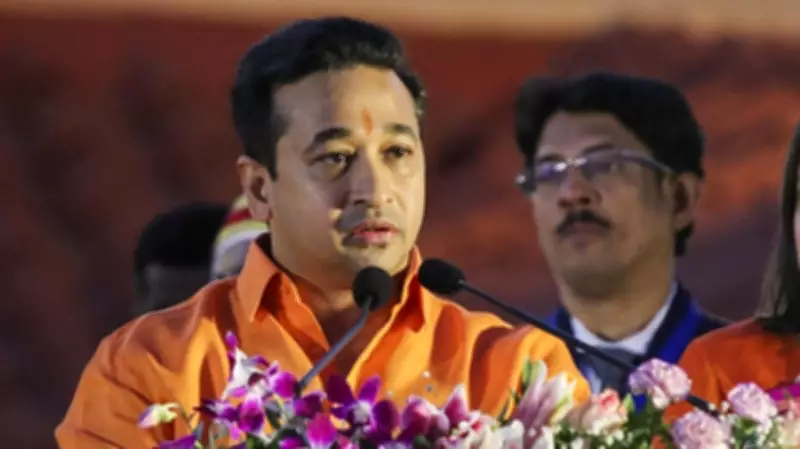
Maharashtra Minister Nitesh Rane Issues Stark Warning Over Zilla Parishad Election Funding
In a dramatic escalation of political tensions in Maharashtra, state minister Nitesh Rane has publicly declared that government funds will be deliberately withheld if candidates from the Shiv Sena (UBT) faction emerge victorious in the upcoming Zilla Parishad elections. This controversial statement has sparked immediate backlash and raised serious questions about the misuse of administrative power for political gain.
Explicit Threat Against Opposition Candidates
Rane, who holds a significant portfolio in the Maharashtra government, made his position unequivocally clear during a recent public address. "We had clearly warned all sarpanches to hand over their gram panchayats to us, or they would not get even a single rupee. As a result, all sarpanches quickly came to our side," he stated bluntly, revealing what appears to be a systematic approach to consolidating power at the grassroots level.
This admission suggests that similar pressure tactics have already been successfully employed at the gram panchayat level, with local leaders reportedly switching allegiance under threat of financial strangulation. The minister's words indicate a troubling pattern where development funds are being weaponized as political tools rather than being allocated based on administrative need or democratic mandate.

Broader Implications for Democratic Processes
The timing of this warning is particularly significant as Maharashtra prepares for crucial Zilla Parishad elections that will determine control over district-level administration and substantial development budgets. Zilla Parishads play a vital role in implementing rural development schemes, infrastructure projects, and social welfare programs across Maharashtra's districts.
Political analysts note several concerning implications of Rane's statement:
- Direct interference in electoral democracy through financial coercion
- Potential violation of constitutional provisions regarding fair allocation of public resources
- Undermining of institutional autonomy of local governing bodies
- Creation of an uneven playing field that disadvantages opposition candidates
Context of Maharashtra's Political Landscape
This development occurs against the backdrop of intense political rivalry between the ruling coalition and the Shiv Sena (UBT), which represents the original faction of the party founded by Bal Thackeray. The split within the Shiv Sena has created one of Maharashtra's most bitter political divides, with both factions vying for control over the party's legacy and electoral base.
Nitesh Rane, son of former chief minister Narayan Rane, has emerged as one of the most vocal critics of the Shiv Sena (UBT) leadership. His latest remarks represent an escalation from verbal criticism to what appears to be an explicit threat of administrative action against political opponents.
Reactions and Potential Consequences
The statement has predictably drawn sharp condemnation from opposition parties and governance experts who argue that such threats undermine the fundamental principles of democratic governance. Critics argue that development funds should be allocated based on objective criteria and local needs rather than political allegiance.
Legal experts are examining whether Rane's statements might violate provisions related to:
- Model Code of Conduct guidelines
- Constitutional guarantees of fair administration
- Anti-corruption legislation regarding misuse of official position
As Maharashtra approaches these critical local elections, Rane's warning has introduced a new dimension of controversy that could influence both electoral outcomes and the broader relationship between state administration and local governance bodies. The incident highlights the increasingly blurred lines between political competition and administrative governance in India's most economically significant state.