Tamil Nadu Polls: Micro Parties Crowd Chennai Constituencies Seeking Visibility
While the Tamil Nadu assembly elections are widely viewed as a three-cornered contest among major political forces, the city of Chennai presents a strikingly different picture. Across its constituencies, nearly 30 micro parties have entered the fray, creating crowded ballot lists that extend far beyond the familiar names of mainstream politics.
The Strategy Behind the Crowded Ballots
These micro parties are not contesting with any realistic expectation of winning seats. Instead, they are pursuing a calculated strategy focused on three key objectives: visibility in the political landscape, bargaining power with larger parties, and establishing future relevance in Tamil Nadu's complex political ecosystem. From Perambur to Kolathur and Velachery, ballot papers read like catalogues of obscure political entities that exist more on affidavit papers than in public memory.
In Perambur, which has gained additional attention this election season due to TVK's Vijay entering the contest, the ballot includes numerous micro parties: Thakkam Katchi, Makkalatchi Katchi, Makkal Murasu Katchi, Makkal Nalvaazhvuk Katchi, Tamilnadu Mahatma Gandhi Makkal Katchi, All India Jananayaka Makkal Kazhagam, Republican Party of India (Athawale), and Tamil Telugu National Party. Similarly, Kolathur—where Chief Minister M.K. Stalin is contesting—features its own pile-up of lesser-known political entities.

Historical Context and Voter Perception
This phenomenon is not entirely new to Tamil Nadu politics. Most of these micro parties previously contested the 2024 Lok Sabha elections, where they made minimal impact on electoral outcomes. Undeterred by their previous performances, they have returned to the political arena with unchanged organizational structures but renewed determination.
For voters, these parties typically represent filler names and symbols that get quickly scrolled past on electronic voting machines. For the candidates themselves, however, this represents a strategic approach to collect just enough votes to negotiate with larger political parties during post-election alliances or future political arrangements.
Candidate Profiles and Campaign Approaches
In Perambur, M. Geeta, a 40-year-old BCom graduate, is contesting on the ticket of Thakkam Katchi—a political party that evolved from an NGO. Her campaign remains modest, extending barely beyond pamphlet distribution and door-to-door visits. "We do not accept donations above 5,000 rupees," she explains. "People must start thinking that big parties are not solving their issues."
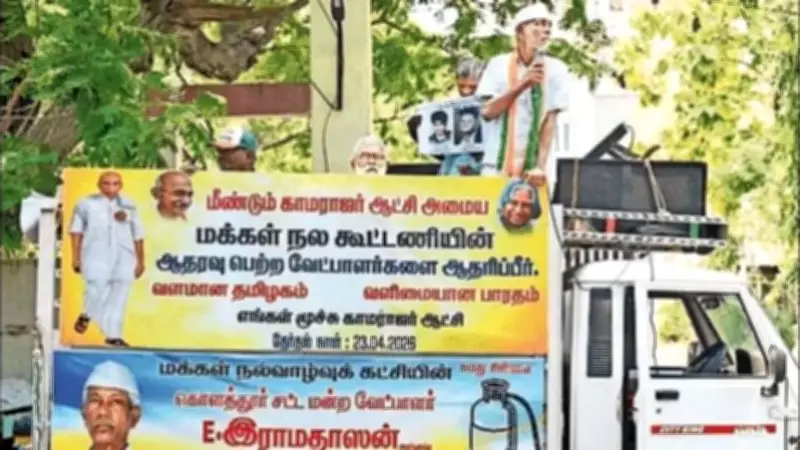
Kolathur presents multiple examples of micro party candidates with specific agendas. E. Raamadasan, a 73-year-old candidate from Makkal Nalvaazhvuk Katchi, is contesting with a single-point agenda: fighting for justice for the mothers of students Harisakthi and Harish, who were murdered in 2025 in Mayiladuthurai district after exposing illicit liquor operations. "The government promised the family support and then denied it," he states. "I want to expose DMK government's corruption and publicity-driven governance."
Also in Kolathur, K. Elumalai of Veerath Thiyagi Viswanathadoss Thozhilalarkal Katchi—registered in 2021—articulates a more direct political strategy. "Our goal is to gain votes so we can ask for seats in big parties and represent our community," he reveals.
Ideological Positions and Economic Visions
From Velachery constituency, Poyyamozhi M. of Proutist Sarva Samaj presents an ideological alternative to mainstream economic systems. "We are an alternative to capitalism and communism," he declares, pitching for what he describes as a comprehensive economic overhaul in the country.
Despite their varied approaches and motivations, these micro parties share a common underlying objective: they are contesting primarily to be noticed within Tamil Nadu's political landscape. The critical question remains whether voters are actually noticing them amid the crowded field of candidates and whether this strategy of seeking visibility through electoral participation will yield the bargaining power and future relevance these parties ultimately seek.