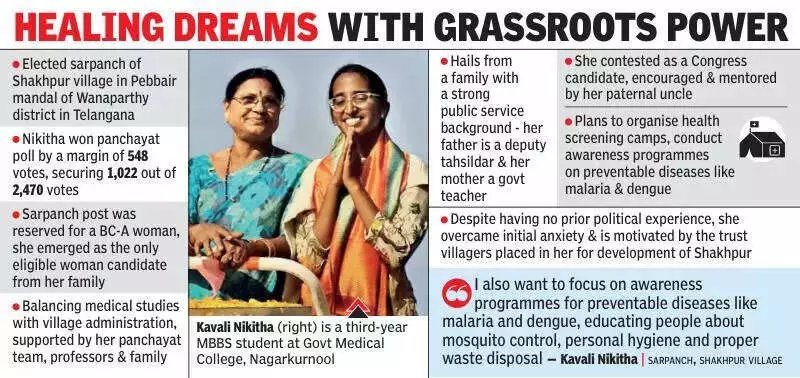
In an inspiring tale of youth stepping into public service, a 21-year-old medical student has been elected to lead her village in Telangana. While her contemporaries are focused on academics, she has taken on the significant responsibility of grassroots governance.
From Medical Textbooks to Village Administration
Kavali Nikitha, a third-year MBBS student at the Government Medical College in Nagarkurnool, has been elected as the sarpanch of Shakhpur village. The village is located in the Pebbair mandal of Wanaparthy district. She won the panchayat poll by a convincing margin of 548 votes, securing 1,022 votes out of the 2,470 votes polled. She defeated four other women candidates in the process.
The sarpanch post in Shakhpur was reserved for a BC-A woman candidate. Nikitha emerged as the only eligible woman candidate from her family. She entered the electoral fray as a Congress candidate, encouraged by her paternal uncle who had political aspirations.

Balancing Dual Responsibilities
Nikitha is now faced with the formidable task of balancing the demanding schedule of her medical education with the duties of village administration. She has a clear plan to manage both roles effectively.
"Most people work between 9 am and 6 pm, which overlaps with my college hours too. In my absence, my panchayat team — the secretary, assistant and three village workers — will manage day-to-day administration," Nikitha explained. She receives support from her professors, seniors, and batchmates for her studies, while her uncle will mentor her in her new role as sarpanch.
Her foray into public service is influenced by her family background. She grew up in a household dedicated to civic duty; her father is a deputy tahsildar and her mother is a government school teacher. Her elder brother is a BTech graduate.
Clear Development Priorities for Shakhpur
Nikitha's vision for Shakhpur is shaped by both her medical training and the village's immediate needs. She identified several critical issues during her campaign.
One of the most pressing problems is the lack of reliable public transport, as the village does not have a regular RTC bus service. Water scarcity is another major concern, exacerbated by limited pipeline infrastructure and irregular supply in several areas.
She also highlighted the absence of an underground drainage system, which creates sanitation and hygiene challenges, especially during the monsoon season. "Repair of wells, construction and maintenance of roads, and better drainage are key issues that need immediate attention," she stated.
Leveraging Medical Expertise for Village Health
Drawing from her medical background, Nikitha plans to launch significant health initiatives for Shakhpur's residents. She aims to organize large-scale health screening camps to assess the overall health status of the villagers.
"I also want to focus on awareness programmes for preventable diseases like malaria and dengue, educating people about mosquito control, personal hygiene and proper waste disposal," she added. Improving water facilities was a central promise of her election campaign.
The young leader admits that the journey has been challenging. "Initially, I felt anxious speaking before large gatherings. I am still learning rural administrative terms and political processes," she said, acknowledging that the lack of prior political experience pushed her beyond her comfort zone. However, she remains motivated: "The trust people have placed in me motivates me to work harder for Shakhpur."