
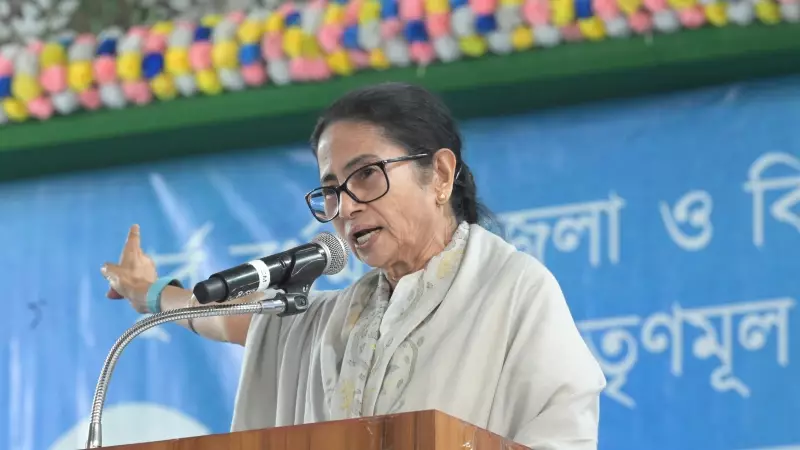
West Bengal Chief Minister Mamata Banerjee, frequently accused by the Bharatiya Janata Party (BJP) of practicing 'minority appeasement,' is spearheading a series of high-profile temple projects across the state. This strategic move is seen by her party, the Trinamool Congress (TMC), as a multi-pronged initiative with significant political and economic benefits.
The Temple Trail: From Digha to Siliguri
The Chief Minister inaugurated a Jagannath temple in the coastal town of Digha in South Bengal on April 30, 2025. This week, she laid the foundation stone for 'Durga Angan,' a 17-acre temple and cultural complex dedicated to Goddess Durga in Kolkata's New Town area. Furthermore, she is scheduled to unveil a Mahakal temple project in Siliguri, North Bengal, in the second week of January 2026.
Defending her actions, Banerjee stated on Monday, "Many people blame me for appeasement politics, but I am a true secularist." She emphasized her participation in festivals of all religions, from attending rozas during Ramzan to covering her head in gurdwaras. "I will pray to Goddess Durga to destroy evil," she added, in a veiled critique of her political opponents.
The Trinamool Congress's Three-Pronged Calculation
Senior TMC leaders outline three core advantages they foresee from this temple-focused drive.
Firstly, it is a direct political counter to the BJP's longstanding allegation of Muslim appeasement. By actively inaugurating and supporting temple construction, Banerjee aims to project a 'truly secular' image and blunt the BJP's primary line of attack. A leader close to the CM said this strategy "takes the wind out of the BJP in Bengal" and is expected to benefit the party in upcoming elections.
Secondly, there is a clear economic and tourism angle. With West Bengal ranking as the second-most popular destination for international tourists in 2025, the government plans to develop religious tourism circuits. These new temple complexes, positioned as centers of art and culture alongside spirituality, aim to attract both domestic and foreign visitors. The Jagannath temple in Digha has already recorded a footfall of 1 crore since its inauguration.
Thirdly, it targets Hindu vote consolidation. While the Muslim vote largely remains with the TMC, a section of Hindu votes has shifted to the BJP, which won 77 seats in the 2021 assembly elections. The temple push, coupled with welfare schemes like Lakshmir Bhandar that appeal to women, is designed to win back a segment of Hindu voters. TMC leaders believe this will thwart the BJP's attempt to build a pan-Hindu base in the state.
Opposition Reaction: BJP in a Bind, Left Cries 'Soft Hindutva'
The strategy has put the principal opposition, the BJP, in a difficult position. While they cannot openly oppose temple construction, leaders have criticized the timing and motive. Union Home Minister Amit Shah remarked, "We welcome the construction of temples, but it is too late." BJP's Leader of Opposition, Suvendu Adhikari, has accused the CM of appeasement even in this context, claiming the Durga Angan site was shifted due to objections from local Muslims.
The Left Front has been more direct in its criticism. CPI(M) Central Committee member Sujan Chakraborty alleged that the CM is engaging in "soft Hindutva politics" to divert attention from the government's failures in development, industrialization, and job creation. "She wants to hide the fact that the government is deeply entrenched in corruption and scams," he stated.
As West Bengal's political landscape heats up, Mamata Banerjee's temple inauguration spree is more than a religious outreach; it is a calculated gambit to reshape her political narrative, boost the state's economy through tourism, and secure a broader social coalition ahead of future electoral battles.