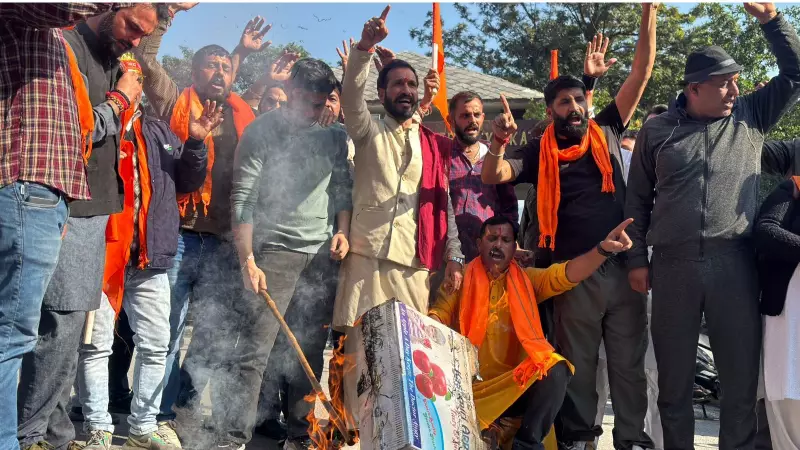
A fierce political storm has erupted in Jammu over the admission of Muslim students to a prestigious medical institute, exposing how the region's identity is being increasingly defined along communal lines. The controversy centers on the Shri Mata Vaishno Devi Institute of Medical Excellence (SMVDIME) and its first MBBS seat-allocation list for the 2025–26 academic batch.
The Spark: A Seat-Allocation List
The dispute ignited after SMVDIME released its admission list, which showed that 42 out of 50 seats were allocated to Muslim students. The institute is financed by the Shri Mata Vaishno Devi Shrine Board, a Hindu religious trust. This outcome prompted immediate backlash from various Hindu groups and political outfits.
These groups argue that an institution funded by donations from Hindu devotees should primarily serve Hindu interests. They have demanded that the admissions list be revoked and that the SMVDIME be officially designated as a "minority institution" for Hindus, which would allow for religion-based reservations. The BJP has escalated the demand, insisting that admissions should be given only to those who have faith in Mata Vaishno Devi.
In response, a delegation led by the Leader of Opposition in Jammu and Kashmir submitted a memorandum to the Lieutenant Governor, who chairs the Shrine Board, seeking cancellation of the list. Meanwhile, the Shri Mata Vaishno Devi Sangharsh Samiti (SMVDSS) has announced plans for an agitation to press for these demands.
Legal Framework and Official Stance
Legally, the situation is clear-cut. Under the National Commission for Minority Educational Institutions (NCMEI) Act, an institution cannot impose religion-based admission criteria unless it has formally secured "Minority Institution" status. The SMVDIME does not hold this status.
Consequently, the admissions were conducted strictly as per the guidelines of the National Medical Council and the state-level NEET pool, based on merit. Chief Minister Omar Abdullah firmly rejected calls to cancel the admissions, stating that students who qualified on merit cannot be denied seats on religious grounds. He warned that allowing religion to dictate institutional decisions could set a dangerous precedent for governance in the Union Territory.
Broader Implications for Jammu's Identity
This controversy transcends a single admission list. Analysts see it as part of a troubling pattern where Jammu's identity is being restructured on religious lines, often in opposition to the Muslim-majority Kashmir Valley. Scholar Rekha Chowdhury notes that sentiments of regional neglect in Jammu have historically been appropriated and communalised by right-wing Hindu organisations.
The current furore raises a critical question: as religious divisions harden, are pressing regional issues like the demand for statehood, land rights disputes, environmental concerns, the domicile policy, and rampant unemployment being pushed to the sidelines?
Furthermore, the proposal to place all SMVDIME MBBS seats in the All India quota—which would likely increase Hindu student intake at the cost of local UT residents—prioritises religious identity over regional rights. This incident follows past tensions in Jammu's educational institutions, including protests over namaz allegations in 2022 and a violent clash over a film in 2023.
The debate forces Jammu to confront difficult questions about whether resources from public charitable trusts can be justifiably denied to a specific community or allocated based purely on faith. As the political storm rages, the future of Jammu's complex, multifaceted identity hangs in the balance, threatened by homogenisation along communal fault lines.