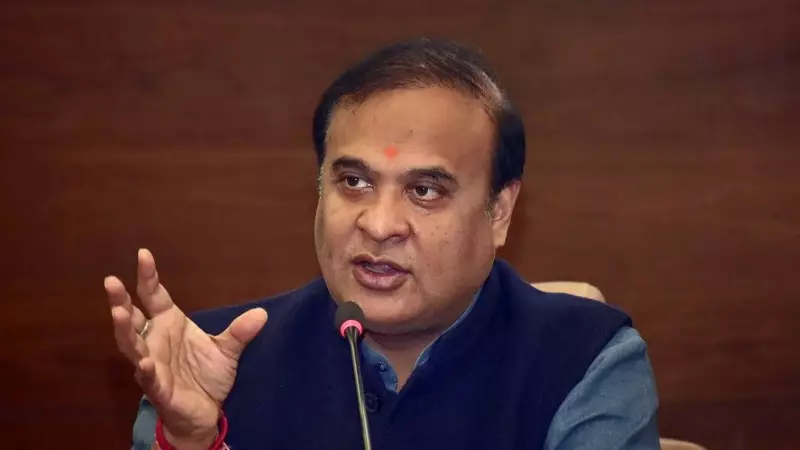
Assam Chief Minister Himanta Biswa Sarma has positioned the upcoming state legislative assembly elections, expected in March-April 2026, as a pivotal "civilisational fight" for the identity and future of Assam. He issued stark warnings about demographic changes and invoked recent events in Bangladesh to underline his argument.
The Core Argument: A Battle for Existence and Identity
Addressing the BJP Assam's two-day State Executive Meeting that concluded on Saturday, Sarma stated that while development remains the BJP government's primary goal, the preservation of identity is equally crucial. He framed the political contest as a clash between two civilizations within the state.
"Our politics is development, and along with that it is preserving the identity," Sarma said. He described one civilization as a 5,000-year-old inclusive Sanatan tradition that accepts all forms of prayer. The other, he alleged, has been fostered over time due to the "weakness and appeasement politics" of the Congress party.
Citing Census Data and a Warning from Bangladesh
The Chief Minister presented census figures to support his narrative. He pointed out that according to the 2011 Census, Muslims constituted 34% of Assam's population. Excluding the approximately 3% of indigenous Assamese Muslims, he claimed Bangladeshi-origin Muslims accounted for 31%.
He projected a concerning trend, stating that this demographic sees a 4% increase with every census. "In the 2027 Census, in Assam, Bangladeshi-origin Miya Muslims will be near 40%," Sarma asserted, framing this as an existential challenge.
To illustrate the potential consequences, he referenced the recent unrest in Bangladesh and the lynching of a Hindu youth, Dipu Chandra Das. "Today, when we see Dipu Das's condition in Bangladesh, then everyone is clearly able to see what situation the Assamese will have to face 20 years later," he warned, suggesting the Assamese majority could face a similar threat in the future.
Questions of Loyalty and Internal Unity
Sarma also raised pointed questions about the loyalties of the Bengali-origin Muslim community in the context of India-Bangladesh relations. He specifically mentioned the strategic "Chicken Neck" corridor connecting Assam to mainland India, noting that populations on both its flanks are primarily those who migrated from Bangladesh.
"Tomorrow, if there is a war between India and Bangladesh, who will these people stand with? Where is the loyalty of these people? Their uncles and grandfathers are still in Bangladesh," he questioned.
Furthermore, the Chief Minister called for unity against "divisions among us," an apparent reference to recent ethnic tensions in the Karbi Anglong district between local Karbi tribals and settled Bihari Hindu communities. He emphasized that every election is a civilizational fight for the survival of the 'jati' (community/identity).
The high-profile meeting was attended by key BJP national leaders including the party's new National Executive President Nitin Nabin, National Vice President Baijayant Jay Panda, and National General Secretary (Organisation) B L Santosh. Alongside his ideological pitch, Sarma also highlighted the developmental work and the reach of beneficiary schemes under his administration.