

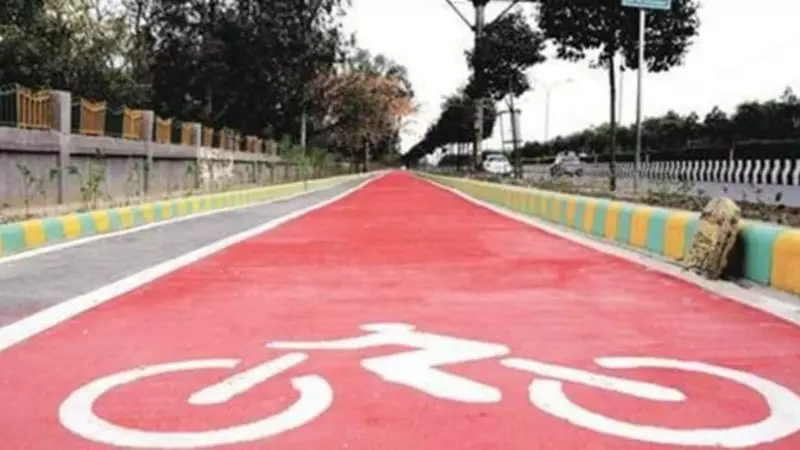
A recent audit of Pune's cycling infrastructure has painted a grim picture, revealing that the city's network of cycle tracks is largely fragmented, unsafe, and encroached. The Cycle Track Audit Report 2025, released by the non-governmental organization Parisar, found that a mere 11 per cent of the audited tracks are in a 'good' condition.
Audit Exposes Critical Deficiencies
The comprehensive audit assessed tracks based on three crucial parameters: safety, comfort, and continuity. The findings were stark. While the Pune Municipal Corporation (PMC) records over 83 km of cycle tracks, Parisar could only meaningfully audit about 35 km. Many stretches existed only on paper or were in such a deteriorated state—faded, broken, or fully encroached—that evaluation was impossible.
Tanzeel Allapur, Project Associate at Parisar, emphasized the interconnected nature of these parameters. "A cycle track is not truly usable unless it performs well in all three parameters: safety, comfort, and continuity. Even one weak link breaks the user experience," Allapur stated on Wednesday. The report underscores the need for a citywide, continuous network rather than isolated stretches to make cycling a viable commuting option.

Safety, Continuity, and Comfort: A Trio of Failures
Safety emerged as the most compromised aspect, with 55 per cent of tracks scoring 'poor' or 'bad'. The audit documented missing segregation from motor traffic, inadequate lighting, absent buffer zones, and dangerous junctions that force cyclists into fast-moving vehicles. Only a few stretches, like Baner Road and Deccan College Road, scored 'good' on safety.
Continuity was another major issue, with tracks frequently ending abruptly or being blocked by poles, debris, or unplanned curbs. Some routes had over 10 obstructions per 500 metres, making uninterrupted cycling impossible. Bibvewadi Road alone had a 420-metre gap where the infrastructure vanished.
Comfort also scored poorly, with only 16 per cent of roads rated 'good'. Many tracks featured broken tiles, uneven surfaces, worn-out asphalt, or were littered with garbage. Roads like Spicer College Road and Sinhagad Road displayed cracked patches and multiple friction points.
Encroachment: The Pervasive Problem
Encroachment was identified as the most widespread and persistent issue. Hawkers, parked two-wheelers, garbage bins, auto garages, and construction debris regularly occupy the dedicated lanes. On one stretch of Bibvewadi Road, auditors recorded 19 vehicle encroachments, with 11 coming from auto garages alone.
PMC's Response and Future Plans
Responding to the audit, PMC officials acknowledged the maintenance challenges. Nikhil Mijar, Transport Planner and Urban Designer in the PMC's Road Department, stated that while the corporation has invested in building tracks, maintaining them requires cooperation from enforcement agencies and citizens.
"Tracks alone won’t promote cycling; greater cycling will demand more tracks, and that will happen by raising awareness and bringing schemes through PPP models," Mijar said. He clarified that traffic management lies with the traffic police, while hawker and encroachment control is the responsibility of ward offices.
PMC also highlighted spatial constraints, noting that cycle tracks can only be built where road width permits. Of a planned 100 km, 83 km are complete, and 15-20 km are under construction. Mijar provided a sobering reality check: "Realistically, only 125 to 150 km of the Pune Cycle Plan’s proposed 800 km can accommodate cycle tracks."
The report points to areas like Kharadi, with its large IT workforce making short 2-3 km commutes, as having high potential for cycling adoption. A small shift here could significantly reduce traffic congestion at notorious bottlenecks like the Mundhwa bridge, demonstrating the broader urban mobility benefits of a functional cycling network.






