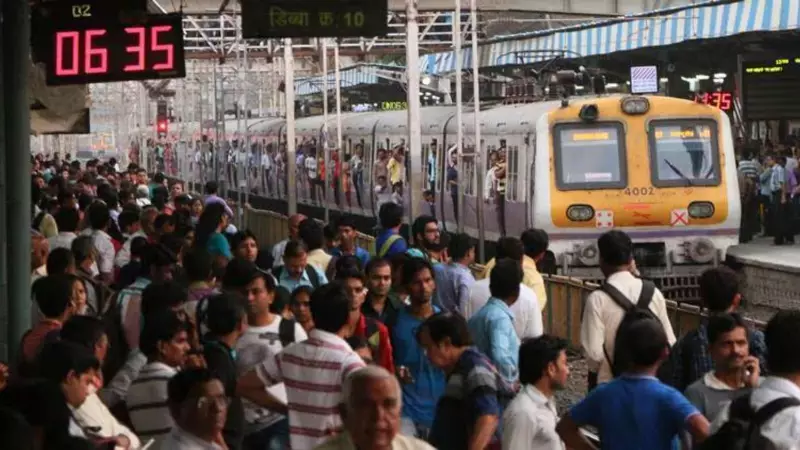
In the immediate aftermath of a tragic accident that claimed five lives on June 9, 2025, the Railway Board issued a swift directive. Following the incident where commuters fell from an overcrowded non-AC local near Mumbra, authorities ordered that all new non-AC rakes for Mumbai must be equipped with automatic door-closing systems. The board set a deadline: deliver two prototype coaches by November 2025 and put them into service by year-end.
With barely three weeks left to that deadline, the promise appears far from being kept. This delay has reignited a complex debate, questioning not just the timeline but the very wisdom of sealing passengers inside Mumbai's notoriously crowded and non-air-conditioned coaches, where travel is already a test of endurance.
A Decade of Promises and Failed Experiments
The demand for automatic doors on Mumbai's lifeline suburban trains is not new. The first significant push came in July 2014 with a ministry-announced pilot project. By September that year, a static demonstration was held on a modified coach. In March 2015, doors were installed on a ladies' coach, with promises of live trials.
The issue gained fresh urgency after the Mumbra tragedy, with both the Railway Board and Union Railway Minister Ashwini Vaishnaw reiterating the commitment. The grim statistics underscore the need: between January 2014 and May 2025, data from the Government Railway Police and RTI reveals that 6,760 commuters died after falling from overcrowded non-AC locals, with another 14,257 injured. Notably, AC locals with regulated entry and automatic doors have recorded zero such fatalities.
Why Previous Trials "Failed Miserably"
Over the past decade, both Western Railway (WR) and Central Railway (CR) have attempted to retrofit automatic door systems onto existing non-AC rakes, with consistently disappointing results.
WR's most extensive experiment occurred between 2016 and 2017 using a system from German manufacturer Knorr-Bremse. The final evaluation was unequivocal. The report found that door operation times routinely exceeded Mumbai's brief station halts of 30 to 60 seconds. During peak hours, sensors detecting obstructions in doorways prevented closure, leading to prolonged dwell times and timetable disruptions.
More critically, the trials exposed a severe ventilation risk. Sealing the doors on non-AC coaches, which lack mechanical air circulation, caused carbon dioxide (CO₂) levels to soar. During peak-hour tests, CO₂ concentrations reached 2,150 parts per million (ppm)—more than triple the permissible limit of 700 ppm. Engineers warned of risks like fatigue, suffocation, and medical emergencies.
The WR headquarters memo ultimately concluded that retrofitting was "not suggested" and such systems should only be deployed on fully air-conditioned, vestibuled trains. CR's experiment in 2025 with a lighter door design yielded nearly identical results, with door motors overheating and sensors failing.
Officials from both railways remain non-committal on the new prototype timeline. Dr. Swapnil Nila, Chief Public Relations Officer for Central Railway, stated that automatic doors would run after new rakes are designed and delivered by ICF Chennai. A senior WR official, speaking anonymously, confirmed that no trial runs or work on a prototype has commenced since the June announcement.
The Affordability Conundrum of the AC-Only Future
Given the repeated failures, the consensus emerging among railway officials is that the only viable path forward is a complete transition to a fully air-conditioned suburban fleet. This shift is being planned under MUTP-3, which includes an order for 238 new AC rakes for Mumbai, with deliveries slated to begin in 2028 and continue through 2031-32.
This timeline aligns with the phase-out of the ageing non-AC fleet, much of which will reach the end of its 25-year lifespan around 2030. A senior Central Railway official stated that as retrofitting non-AC trains is not viable, converting the entire fleet to AC is the sole solution to the door-safety issue.
However, this "solution" introduces a formidable new challenge: affordability. The fare gap is stark. A non-AC ticket from CSMT to Kalyan costs Rs 15, while the AC fare is Rs 105. For monthly passes, the difference is even more dramatic: Rs 315 for non-AC versus Rs 2,135 for AC on the same route.
This has raised serious concerns among daily commuters. Ramesh Kumar, a construction worker, highlighted the dilemma, stating that at his daily wage of Rs 600, paying Rs 35 for a single AC ride would make two trips a day unaffordable. Students like Anil Patil worry that an AC monthly pass could cost more than their college tuition for a subject.
Recognizing this crisis, Chief Minister Devendra Fadnavis has indicated that the government may consider fare subsidies for AC locals, even while committing to an AC fleet.
The shift to AC trains may finally end the decade-long chapter of failed automation trials and reduce fall-related deaths. But unless fare reforms are implemented in tandem, Mumbai's next suburban crisis may not be about safety, but about the basic affordability of its daily commute for millions.