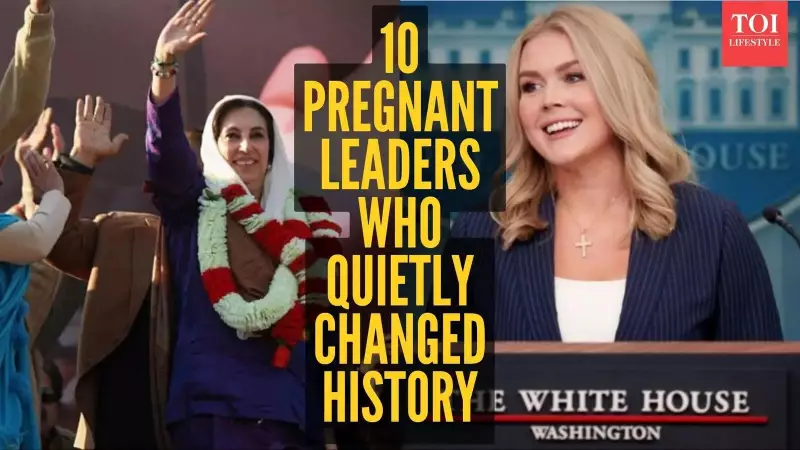
In a move that has electrified political discourse, White House Press Secretary Karoline Leavitt recently announced she is expecting her second child while continuing in her high-profile role. The 28-year-old shared the news via a festive Christmas post on social media, revealing that a baby girl is due in May 2026.
A Historic Announcement and Its Resonance
This marks a historic first for someone serving as White House Press Secretary, a position that has never before been held by a pregnant woman. Leavitt's decision to continue her duties while expecting has ignited a national conversation in the United States about work-life balance for women in politics. It breaks a long-standing unofficial mould and reflects a growing acceptance of mothers in high-pressure political environments.
The announcement resonated far beyond Washington, tapping into a broader global shift in how society perceives leaders who are also nurturing families. While she has faced a mix of admiration and gendered critiques on social media, her story underscores how modern political life is evolving to include the realities of family and leadership simultaneously.

Global Pioneers of Pregnancy in Office
Karoline Leavitt is far from alone in bridging motherhood and public service. Around the world, several prominent figures have paved the way, demonstrating that pregnancy and leadership are not mutually exclusive.
Jacinda Ardern, the former Prime Minister of New Zealand, gave birth while in office in 2018, becoming one of the few democratically elected leaders to do so. She famously brought her infant to the United Nations General Assembly.
In a groundbreaking moment decades earlier, Yvonne Brathwaite Burke became the first US Congresswoman to give birth while serving in 1973.
Benazir Bhutto of Pakistan made history in the late 1980s as the first woman to lead a Muslim-majority country and is widely regarded as the first head of government known to be pregnant while in office.
Other notable examples include:
- Jane Swift (US): Served as acting Governor of Massachusetts while giving birth to twins.
- Kristina Schröder (Germany): Served in Chancellor Angela Merkel’s cabinet and gave birth while in office.
- Tammy Duckworth (US): Became the first sitting US Senator to give birth in 2018, prompting rule changes to allow infants on the Senate floor.
- Stella Creasy (UK): Her advocacy led to reforms in the UK Parliament’s proxy-voting system for MPs on maternity leave.
- Irene Montero (Spain): As Minister for Equality, she openly integrated pregnancy and motherhood into her public image and policy agenda.
These examples, spanning continents and political systems, show that what was once rare is becoming part of the political narrative itself.
The Changing Face of Political Leadership
The increased visibility of pregnant politicians mirrors wider societal shifts. Decades ago, a pregnant leader was an anomaly. Today, it sparks necessary discussions about workplace flexibility, family policy, and institutional reform.
Political systems are gradually adapting. In the US, state legislatures have begun allowing remote voting post-childbirth. The UK updated its proxy-voting rules. These are small but symbolic shifts in tradition-bound institutions.
Figures like Leavitt, Ardern, Bhutto, and others are collectively redefining what it means to balance family planning with public service. They are pushing governments worldwide to reconsider old norms around parental leave, caregiving, and the public's expectations of their leaders. This trend marks a significant cultural shift towards a more inclusive, humane, and realistic vision of leadership for the 21st century.