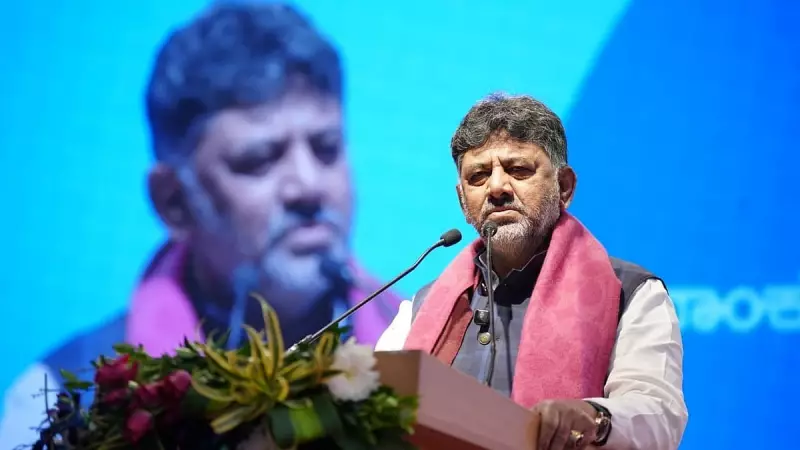
In a surprising political development, Karnataka Deputy Chief Minister D.K. Shivakumar has publicly stated that he was the one who approached the Delhi Police, urging them to file a First Information Report (FIR) in the high-profile National Herald case. This case involves senior Congress leaders, including members of the Gandhi family.
Shivakumar's Strategic Admission
Shivakumar made this revelation during an interaction with journalists in Bengaluru on Saturday. He framed his action not as an act of opposition to his own party but as a calculated political maneuver. The Deputy CM argued that by pushing for an FIR to be registered by the Delhi Police, he aimed to bring the investigation under the jurisdiction of the local police rather than central agencies like the Enforcement Directorate (ED).
He expressed a clear distrust of central investigative bodies, which he alleged are often used as tools by the ruling party at the Centre to target political opponents. "I thought let there be an FIR by the Delhi Police and let them investigate," Shivakumar was quoted as saying. His implication was that a police investigation might be perceived as more impartial compared to one conducted by the ED.

The Context of the National Herald Case
The National Herald case is a long-running legal and political saga. It involves allegations of financial irregularities associated with the acquisition of the now-defunct National Herald newspaper by Young Indian Pvt Ltd, a company in which Congress leaders Sonia Gandhi and Rahul Gandhi are major stakeholders. The complainants have alleged that party funds were misused for this acquisition.
For years, the case has been investigated by the ED, which probes financial crimes. The agency has conducted raids, questioned the Gandhis and other Congress officials, and filed charges. The Congress has consistently labeled the case as "political vendetta" orchestrated by the Bharatiya Janata Party (BJP)-led central government.
Shivakumar's admission sheds light on the behind-the-scenes legal strategies employed by political parties. By seeking an FIR, he attempted to change the course of the investigation's oversight, potentially moving it away from an agency under the central government's direct administrative control.
Political Reactions and Implications
This revelation is significant as it comes from a senior Congress leader and the head of the party's government in Karnataka. It openly acknowledges an attempt to legally navigate around central agencies. Political analysts suggest this move was likely a tactic to dilute the intensity of the ED probe or to create parallel legal proceedings that could complicate the central agency's case.
The BJP was quick to seize upon Shivakumar's statement. They have used it to bolster their claim that the Congress is trying every possible method to evade a proper investigation into the National Herald matter. BJP leaders have accused the Congress of "forum shopping" and attempting to manipulate the legal process.
Within the Congress, the statement has caused some unease, as it publicly highlights internal legal strategies. However, no senior party leader has openly contradicted Shivakumar. The episode underscores the high-stakes legal battles that define Indian political rivalries today, where investigative agencies are frequently at the center of political controversy.
Ultimately, Shivakumar's strategy did not succeed in stopping the ED's investigation. The probe by the central agency continues, and the case remains active in the courts. However, his admission provides a rare glimpse into the defensive legal and political tactics parties employ when their top leadership is under scrutiny.