

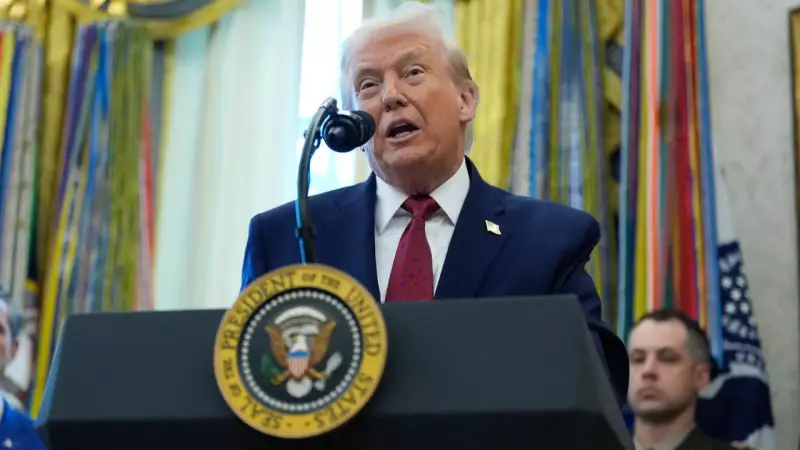
US President Donald Trump declared on Monday that a peace agreement to conclude the four-year-long conflict between Ukraine and Russia is now "closer than ever." He based this optimistic assessment on recent high-level discussions held in Berlin involving European leaders and Ukrainian President Volodymyr Zelenskyy.
Unprecedented Support from European Allies
Speaking from the White House, Trump revealed that the United States is receiving "tremendous support" from key European nations eager to see an end to the hostilities. He specifically named Germany, Italy, France, the United Kingdom, Poland, Norway, Denmark, Finland, and the Netherlands as being actively involved. "We are going to get it done. I think we are closer now, and they will tell you that they are closer now with numerous conversations with President Putin of Russia," Trump stated. He emphasised the humanitarian goal, adding, "We want to save a lot of lives."
However, the President also acknowledged the significant challenges in finalising a deal. He noted the historical difficulty in aligning both Russia and Ukraine on the timing and specific terms of any settlement. "At this moment, Russia wants to get it, but the problem is they will want to end it, and all of a sudden they want it, and Ukraine will want to get it ended and all of a sudden they won't. We have to get them on the same page," Trump explained, referencing past setbacks that had undermined his earlier optimism.

Berlin Talks and Key Sticking Points
The President's comments followed two days of intensive diplomatic negotiations in Berlin. The US delegation was represented by Trump's foreign envoy, Steve Witkoff, and his son-in-law, Jared Kushner. Trump himself joined a dinner of European leaders via a phone call on Monday to discuss the emerging framework and held separate calls with his envoys as the talks progressed.
A senior US official indicated that approximately 90 per cent of the issues between the warring nations have been resolved. The most persistent obstacle remains the question of territorial concessions. To break this deadlock, the US has proposed innovative ideas, including the creation of an "economic free zone," as reported by CNN.
Meanwhile, European leaders have reportedly agreed in principle to participate in Western security guarantees for Ukraine, a critical demand from Kyiv. Al Jazeera reports that control over territory continues to be a primary hurdle. In a significant potential compromise, President Zelenskyy has previously signalled Ukraine's readiness to relinquish its bid for NATO membership in exchange for robust, long-term security assurances from its Western partners.
Reconstruction and Ongoing Hostilities
Beyond the ceasefire terms, this week's discussions also covered plans for Ukraine's post-war reconstruction. Representatives from the global investment firm BlackRock held talks with Ukrainian officials regarding potential financial support for rebuilding efforts. The future status of the Zaporizhzhia nuclear power plant was also raised, though this complex issue remains unresolved.
Even as diplomacy advanced, violence continued on the ground. Ukrainian officials reported that overnight, Russian forces launched 153 drones at targets within Ukraine, with 17 reportedly reaching their objectives. In a conflicting claim, Russia's defence ministry stated that its air defences had shot down 130 Ukrainian drones.
While cautiously hopeful, Trump summarised the delicate state of negotiations: "Things are seemingly going well, but we’ve been saying that for a long time, and it’s a difficult one." The world now watches to see if this renewed diplomatic push can finally bridge the final gaps and end Europe's largest armed conflict in decades.






