

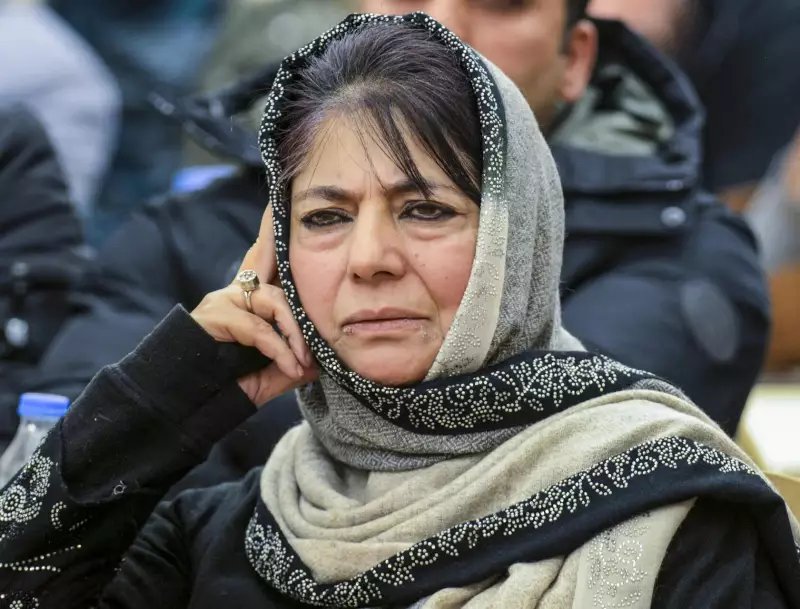
Shiv Sena (UBT)'s Jammu and Kashmir unit president, Manish Sahni, issued a strong demand on Monday, calling for a public apology from Peoples Democratic Party (PDP) chief Mehbooba Mufti. This demand comes in response to Mufti's recent characterization of India as "lynchistan," a comment made in the wake of two separate violent incidents.
The Controversial 'Lynchistan' Remark
On Sunday, Mehbooba Mufti launched a sharp critique, alleging that the India of Mahatma Gandhi and Jawaharlal Nehru had been transformed into what she termed "lynchistan." Her remarks were linked to the tragic killing of a labourer from West Bengal in Odisha's Sambalpur district and the death of a tribal MBA student in Uttarakhand.
Manish Sahni responded forcefully, stating that Mehbooba Mufti has no right to abuse the country. He framed her criticism as an act of biting the hand that feeds, arguing that condemning an entire nation due to the actions of a few mischievous elements is unacceptable.

Historical Accusations and Counter-Charges
Sahni did not stop at demanding an apology. He turned the spotlight on Mehbooba Mufti's own political legacy and silence on key issues. He pointedly questioned her and the PDP's silence on the carnage of Hindus in Bangladesh and the ongoing persecution of Hindus and other minority communities in Pakistan.
In a move to recall painful history, Sahni reminded the PDP chief of her party's silence during the exodus of Kashmiri Pandits from the Valley in the 1990s, a period when Islamist militants forced the community to flee.
References to Terrorism and a Hostage Crisis
The Shiv Sena (UBT) leader further escalated his accusations by alluding to recent security concerns. "It is no secret which community was involved in the white-collar terrorist module that was exposed after the Delhi bomb blast," Sahni said. This was a reference to the November 10 fidayeen attack near the Red Fort, carried out by Umar Mohammed, a doctor based in Pulwama.
Sahni concluded with a personal historical reminder directed at Mehbooba Mufti. He noted that on December 8, 1989, India released five dangerous terrorists in exchange for the release of her sister, Rubiya Saeed. This negotiation happened when her father, Mufti Mohammad Saeed, served as the Union Home Minister.
The political confrontation highlights the deep and ongoing tensions in Indian politics, where present-day criticisms are often met with historical counter-narratives concerning national security, minority rights, and political accountability.






