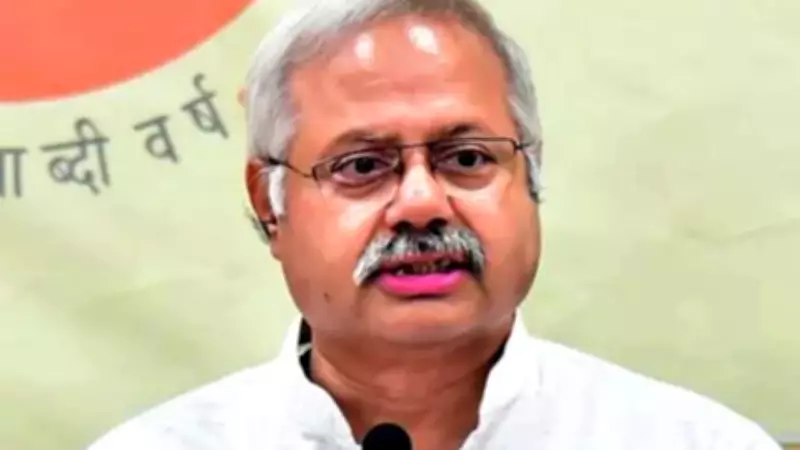
RSS Clarifies Position on Caste Census and Social Issues in Exclusive Interview
In a detailed interaction with The Times of India, RSS national publicity head Sunil Ambekar articulated the Sangh's nuanced stance on the contentious issue of caste census, drawing a clear distinction between welfare objectives and political exploitation. Ambekar emphasized that while the RSS supports caste-based data collection for developmental purposes, it firmly opposes any attempts to use such information to fragment society along communal lines.
Social Harmony Over Structural Confrontation
Ambekar framed the RSS's approach to caste through the lens of social harmony rather than adversarial confrontation. "If mutual affection grows and discrimination disappears, even large issues can be resolved. Without harmony, even small issues become major conflicts," he stated, underscoring the organization's philosophy. He highlighted practical measures being undertaken at the grassroots level, where RSS volunteers actively work to ensure equal access to temples, cremation grounds, water sources, and public spaces for all communities.
The RSS leader pointed to the expanding network of affiliated institutions such as Vidya Bharati, Vanvasi Kalyan Ashram, Ekal Vidyalaya, and Seva Bharati as evidence of the Sangh's broader outreach. He noted with satisfaction that leadership roles within these organizations are increasingly being assumed by individuals from marginalized communities, including a growing number of women.

Women's Participation and Organizational Structure
On the topic of women's involvement, Ambekar defended the parallel structure of the Rashtriya Sevika Samiti, explaining that it mirrors the RSS shakha model while catering specifically to women. He acknowledged the ongoing need to expand women's roles further and revealed that participation in decision-making and outreach activities is steadily increasing through a coordination mechanism known as "Mahila Sambandh."
Ambekar also highlighted the centenary theme of "Kutumb Prabodhan," which aims to encourage families to support women's active participation in public life, reflecting a gradual but deliberate shift in societal attitudes.
Caste Census: Welfare vs. Political Mobilization
Reiterating the RSS's position on caste census, Ambekar clarified: "Democracy requires representation, but politics should not pit one community against another." He argued that societal unity serves as the most effective counter to divisive political mobilization. Despite widespread perceptions of polarization, Ambekar contended that "on the ground we see unity," citing massive gatherings such as the Kumbh Mela and the Ram Mandir consecration as evidence of underlying social cohesion.
RSS-BJP Equation and Civilizational Vision
Addressing the often-discussed relationship between the RSS and the Bharatiya Janata Party (BJP), Ambekar emphasized that the Sangh remains fundamentally a social organization focused on "building individuals." He noted that swayamsevaks (volunteers) work across various sectors, including politics, but stressed that all organizations operate independently within India's unique "society-centric" framework, which contrasts with Western state-centric models.
While political parties function within short-term electoral cycles, Ambekar explained that the RSS operates on a longer civilizational horizon through initiatives like "Lokmat Jagran" (public consciousness awakening). He rejected criticism linking Hindu nationalism to democratic backsliding, describing Hindu culture as inherently "unifying" and rooted in principles such as "Vasudhaiva Kutumbakam" (the world is one family).
Addressing Regional and Global Concerns
On concerns regarding discrimination against people from northeastern India, Ambekar argued that the term "racial discrimination" is misplaced. He attributed past tensions to historical distortions and limited interaction, noting that exchange programmes have significantly reduced misunderstandings. He called for sensitive and nuanced handling of such issues to foster greater national integration.

Regarding global conflicts, including the ongoing tensions in the Middle East, Ambekar stated that India should be guided by principles of peace and strategic assessment, with the government making decisions based on national interest and diplomatic considerations.
Through this comprehensive interview, Sunil Ambekar has provided a clear window into the RSS's evolving stance on critical social and political issues, balancing traditional values with contemporary challenges.