

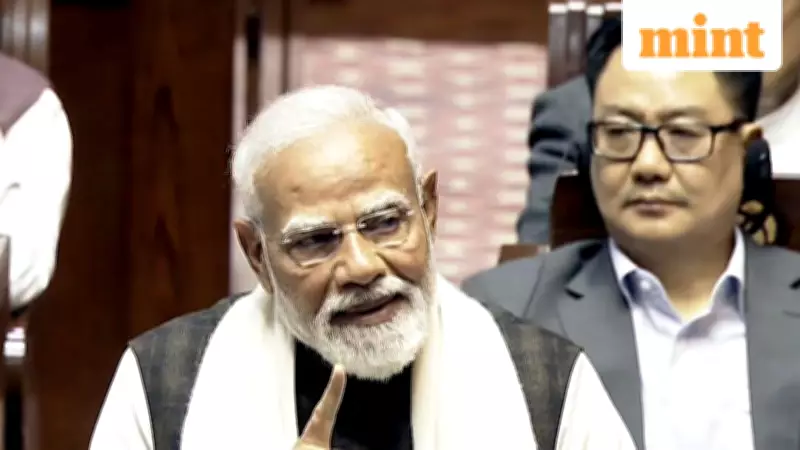
Prime Minister Narendra Modi Delivers Scathing Critique in Rajya Sabha
Prime Minister Narendra Modi launched a comprehensive and pointed attack on Opposition parties during his response to the President's motion of thanks in the Rajya Sabha on Thursday. The Prime Minister's address was marked by poetic flourishes and direct criticism aimed at multiple political opponents.
Poetic Barbs Directed at Opposition Parties
In a notable rhetorical move, Prime Minister Modi turned to shayari (poetic verse) to deliver his message to the Opposition. He specifically targeted the Congress party, DMK, Trinamool Congress (TMC), and Aam Aadmi Party (AAP) with the poetic lines: 'Tum kitna duniyako dhoka doge, aaina dekh liya, toh apni sacchai kaha chupaoge' which translates to 'How much will you deceive the world? When you look in the mirror, where will you hide your truth?'
This poetic critique formed the centerpiece of his broader argument about transparency and accountability in political discourse.

Specific Criticism of Trinamool Congress and Congress Leadership
Prime Minister Modi directed particular attention toward the Mamata Banerjee-led Trinamool Congress government in West Bengal. He asserted that 'the ruthless government in Bengal is setting new records in all parameters of decline', suggesting significant governance failures in the state.
During the initial portion of his parliamentary address, Prime Minister Modi also commented on Congress leader Mallikarjun Kharge's participation in Opposition sloganeering. Showing apparent concern for the senior politician's wellbeing, Modi suggested: 'Meri ek prarthana hai, adarniye Kharge ji ki umar dekhte huye, wo baith kar bhi naare bol sakte hain toh accha hoga, taaki unko kasht na ho' which means 'I have one request. Considering Kharge ji's age, it would be better if he could raise slogans while seated, so that he does not face any discomfort.'
He further elaborated: 'Peeche naujawan bahot log hain, toh Kharge ji ko baithke bhi naare bolne ki anumati de dijiye' translating to 'There are many young people standing behind him, so please allow Kharge ji to chant slogans even while sitting.'
Context of Parliamentary Proceedings
Prime Minister Modi's Rajya Sabha address followed significant disruptions in the Lok Sabha on Wednesday. Women Members of Parliament from Opposition parties had gathered around the Prime Minister's seat holding banners ahead of his scheduled address, leading to substantial disruptions that ultimately resulted in the suspension of proceedings for that day.
The current parliamentary session represents a crucial period for legislative business and political debate in India's democratic framework.
Budget Session Timeline and Structure
The Budget Session of Parliament, which commenced on January 28, is scheduled to conclude on April 2. Both Houses of Parliament will observe a recess period beginning February 13, with proceedings resuming on March 9.
This recess period allows Standing Committees to conduct detailed examinations of the Demands for Grants from various ministries and departments, representing an essential component of parliamentary oversight and budgetary scrutiny.
The session's structure facilitates both legislative action and thorough review of government financial proposals, creating multiple opportunities for parliamentary debate and political engagement across party lines.






